"I Survived. I Lived. Then I Woke Up."

The 1994 adaption of Street Fight & Mindset
Stop letting setbacks define your identity. Learn how the "Street Fighter Tuesday" logic can build Stoic resilience and an unbreakable professional baseline.
Christopher J
2/16/20265 min read
The Bison Paradigm: Why Your Crisis Should Just Be a "Tuesday"
In the history of cinema, few movies are as universally panned as the 1994 adaptation of Street Fighter. It was loud, chaotic, and largely missed the mark for fans of the game. However, buried within that neon-lit shipwreck is a single scene that has arguably become more culturally significant than the entire video game franchise.
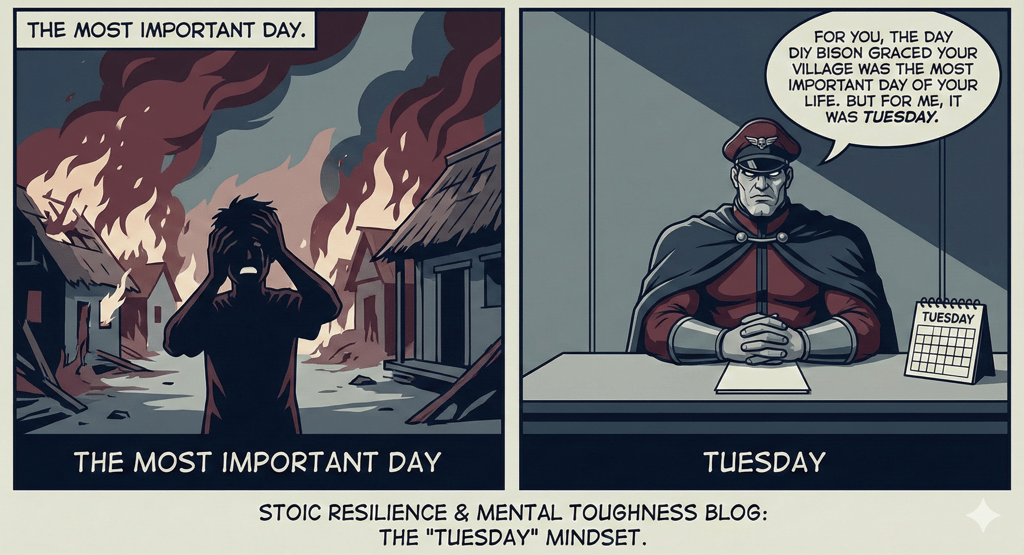
It is the moment the protagonist, Chun-Li, finally confronts the villainous General M. Bison. She delivers a tear-filled, soul-crushing monologue about how Bison destroyed her village and murdered her father on a specific, life-altering day years prior. She has spent her entire existence fueled by this trauma, sharpening her skills for this one moment of vengeance.
Bison’s response? He doesn't even look up from his desk. He simply says:
"I'm sorry. I don't remember any of it... For you, the day Bison graced your village was the most important day of your life. But for me, it was Tuesday."
This line is more than just a legendary "villain burn." It represents a profound psychological concept known as the "Tuesday Mindset." It is the idea that what one person perceives as a monumental, high-stakes, or traumatic event is, for another, merely a mundane occurrence.
1. The Asymmetry of Importance: Why the "Villain" Wins
The resonance of this quote lies in what we call Villain's Nihilism. In a traditional story, we expect the antagonist to relish their cruelty. We expect them to remember the faces of those they’ve hurt because it validates the hero's struggle.
Bison subverts this entirely. By forgetting the event, he establishes an absolute asymmetry of importance.
The Hero’s Perspective: The event is an obsession, a defining trauma, and the "most important day" of their life.
The Villain’s Perspective: The event is a routine task, a clerical error, or a "Tuesday".
This indifference makes a character appear more formidable than any display of rage ever could. It suggests that the hero’s "extreme" is the villain’s "baseline". They aren't even trying to be cruel; they are simply performing their routine.
In our daily lives, we often find ourselves in Chun-Li’s position. We obsess over a "catastrophic" mistake at work or a social slight, treating it as a life-altering event. Meanwhile, the "villain" (the boss, the client, or the universe itself) doesn't even realize anything happened. They are already on to the next "Tuesday."
2. Stoicism and the "Business as Usual" Fortress
While Bison uses this logic for evil, the "Tuesday Mindset" has evolved into a powerful tool for Stoic emotional regulation.
To a Stoic, chaos is inevitable. The world will "grace your village" with unexpected stressors, market crashes, or personal setbacks. The goal is to move from being the person whose life is defined by the event to the person who views the event with a "business as usual" attitude.
The Internal Baseline
If you treat every challenge as "the most important day of your life," you are in a state of constant, unsustainable hyper-arousal. You are reactive, emotional, and easily manipulated by circumstance.
When you adopt the Tuesday Mindset, you harden your baseline. You recognize that:
Indifference is a Fortress: By refusing to grant an event "monumental" status, you strip it of its power to destabilize you.
Emotional Regulation: You face chaos not with panic, but with the calm of a professional performing a routine task.
This isn't about being a villain; it’s about being an unshakable professional. It’s about ensuring that your internal state is governed by your own standards, not by the "gracing" of external events.
3. High Performance as a Baseline: The "Another Day at the Office" Effect
We see this mindset most clearly in elite athletes and high-performers. When a player hits a game-winning shot in the NBA or a surgeon performs a miracle operation, the crowd sees it as "the most important day." But for the performer, it is "just another day at the office".
This is the "Big Bad" Trope applied to human achievement. To the observer, the feat is an "extreme." To the performer, the feat is the "baseline".
The Preparation: Professionals train so hard that the "impossible" becomes a routine task.
The Psychological Buffer: By viewing a high-stakes moment as "just a Tuesday," they lower their anxiety and allow their training to take over.
If you view your goals as a "monumental struggle," you will likely choke under the weight of the importance. If you view your goals as "what I do on Tuesdays," you create the psychological space necessary for execution.
4. Cultural Evolution: From Meme to Mental Model
Raul Julia’s performance as Bison was legendary, transforming a critically panned film into a source of enduring wisdom. The "Tuesday" line has transitioned from an internet meme into a broader psychological concept used to describe:
Professionalism: Describing a difficult feat as routine to demonstrate mastery.
Resilience: Facing trauma by refusing to let it become your identity.
The Narrative Pivot: In writing and storytelling, using this trope to show a character is so powerful they operate on a different plane of existence.
In a world that constantly tries to tell you that every news cycle, every trend, and every minor failure is "the most important day of your life," the most radical thing you can do is look back and say, "It was just Tuesday."
5. How to "Tuesday" Your Challenges
To implement this mindset, you have to change your relationship with stress. You have to move from the "Hero's Obsession" to the "Master's Baseline."
Step 1: Audit the Asymmetry
The next time you are spiraling over an event, ask yourself: "Is this the most important day of my life, or is it just a Tuesday for the rest of the world?" Realizing that the universe is largely indifferent to your "crisis" is actually incredibly freeing. It allows you to put the event back in its box and move on.
Step 2: Practice Reactive Resilience
Condition your brain through intentional discomfort so that high-stress situations feel familiar. If you have practiced being calm in the cold, or calm under a heavy barbell, a "monumental" stressor at work starts to look a lot more like a routine task.
Step 3: Shift the Narrative
Stop telling the story where you are the victim of a "life-altering event." Start telling the story where you are the professional who handled a Tuesday. Chun-Li was trapped by Bison's memory; Bison was free because he didn't care. Be the one who is free.
Final Thoughts
The "Tuesday Mindset" is not about a lack of empathy or a descent into nihilism. It is about the reclamation of your own importance. When you decide that a crisis is "just a Tuesday," you are declaring that your internal peace is more important than the external chaos.
You are deciding that no "Bison"—no event, no person, and no failure—has the power to grace your village and change the trajectory of your life without your permission.
Next time the world tries to give you its "worst," just remember: it's only Tuesday.

Do you have a life changing story and want to help others with your experience and inspiration. Please DM me or Send me an email at the links below
Contact Me
© 2025. All rights reserved.
Privacy Policy