"I Survived. I Lived. Then I Woke Up."

The 100 Doors to Nowhere: Why Indecision is the Ultimate Choice
A powerful story about the cost of indecision and the illusion of endless options. Explore how analysis paralysis, fear, AI‑driven overwhelm, and Stoic philosophy shape modern decision‑making — and learn practical strategies to choose action over hesitation.
Chritopher J
1/12/20264 min read
The 100 Doors to Nowhere: Why Indecision is the Ultimate Choice
I Heard a story that I want to share :
A man found himself in a room with 100 doors. each promised something different -Love, fame, peace, power. A voice echoed" "you can open any door you want but once you choose you can never comeback" He panicked " what if i choose wrong" he sat down o to think and years passed . He never opened a single one. when the voice returned, it whispered " you're time is up" The man screamed " BUT I never chose!" The voice replied " YOU DID. YOU CHOSSE FEAR" The door vanished . the room grew dark, all that remained was regret. The lesson: Indecision is still a decision. Every moment you hesitate. life quietly closes anther door."
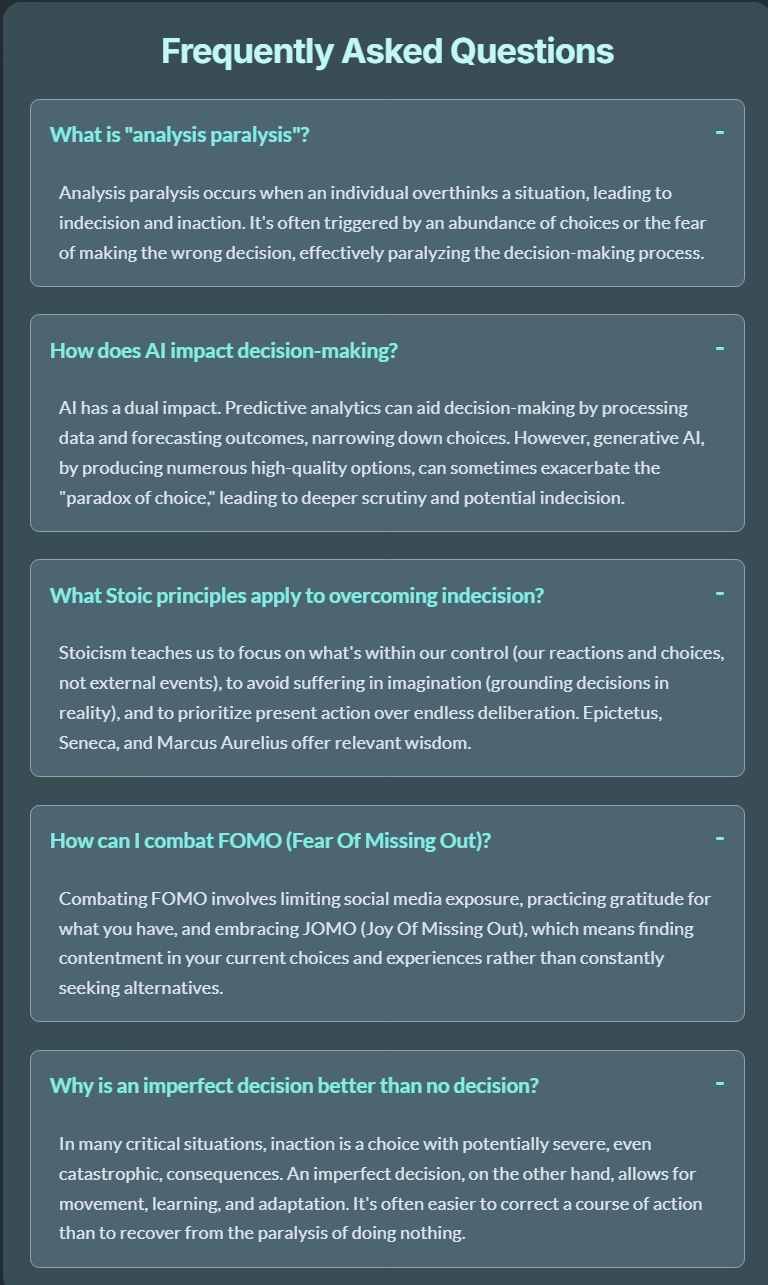
This isn't just a story; it's a mirror reflecting one of the modern world's most pervasive, yet insidious, maladies: analysis paralysis.
The Modern Malady: Drowning in Options
In an era defined by hyper-connectivity and endless options, we are simultaneously empowered and paralyzed. From streaming services offering an unmanageable catalog of shows to the paradox of choice in everyday consumer decisions, our cognitive load is heavier than ever. This deluge of choice, rather than liberating us, often leads to "analysis paralysis," a state where overthinking and fear of suboptimal outcomes prevent any action at all. The modern brain, evolved for scarcity, struggles to navigate an abundance it was never designed for.
Predictive Analytics: A Beacon in the Fog
AI, with its ability to crunch vast datasets, assess risks, and forecast outcomes, offers a potent antidote to indecision. For businesses, predictive analytics can narrow down strategic choices, boosting confidence and accuracy. For individuals, tools leveraging AI can help prioritize tasks, recommend optimal paths, and even personalize learning, effectively reducing the cognitive burden and providing clearer choices.
Generative AI: Deepening the Cognitive Trenches?
However, generative AI presents a fascinating paradox. While it saves immense time on ideation by crafting numerous well-written options, it can inadvertently amplify the "paradox of choice." Suddenly, instead of struggling to produce one good idea, we're presented with ten excellent ones, each requiring deeper scrutiny, leading to even more profound "cognitive trenches" of indecision. The more perfect options, the more perfect the potential for regret.
Beyond Metaphor: Life-and-Death Decisiveness
The story of the 100 doors, while allegorical, has chilling real-world parallels. Consider a climber caught in a blizzard, faced with multiple routes, each carrying risk. Or an emergency room surgeon making split-second decisions with imperfect information. In these high-stakes scenarios, decisive action—even if imperfect—is paramount. Inaction is not a neutral stance; it is a choice with often fatal consequences, far more perilous than a potentially flawed decision.
Stoic Wisdom: Ancient Guides for Modern Choices
Ancient Stoic philosophy offers timeless principles for cultivating clarity and decisiveness:
Epictetus: Focus on what is within your control – your thoughts, reactions, and choices. External events are indifferent. This liberates us from the anxiety of factors beyond our influence.
Seneca: "We suffer more often in imagination than in reality." Ground your decisions in present reality, not exaggerated fears of future outcomes. Many imagined consequences never materialize.
Marcus Aurelius: Emphasizes the power of your mind over external events and the importance of present action. "Waste no more time arguing about what a good man should be. Be one."
Cultivating Decisiveness:
Set Deadlines: Impose artificial (or real) deadlines for decisions.
Prioritize: Identify truly important decisions from trivial ones.
Satisfice: Aim for "good enough" rather than perfect. Perfection is the enemy of action.
Clarify Values: Base decisions on your core values.
Limit Options: Strategically reduce the number of choices presented.
Seek Perspective: Consult trusted advisors, not just for validation, but for different viewpoints.
Embrace Imperfection: Accept that not every decision will be optimal, but every decision is a learning opportunity.Taming FOMO (Fear Of Missing Out):
Limit Social Media: Reduce exposure to curated highlights of others' lives.
Practice Gratitude: Focus on what you have, not what you might be missing.
Embrace JOMO (Joy Of Missing Out): Find contentment in your present choices and experiences.
Taming FOMO (Fear Of Missing Out):
Limit Social Media: Reduce exposure to curated highlights of others' lives.
Practice Gratitude: Focus on what you have, not what you might be missing.
Embrace JOMO (Joy Of Missing Out): Find contentment in your present choices and experiences..
Proactive Well-being:
Prioritize Self-Care: Adequate sleep, regular exercise, and stress reduction are foundational for clear thinking.
Emotional Awareness: Address underlying anxiety or self-doubt that fuels indecision.
Foster Flexibility: Be adaptable; not every plan needs to be rigid.
Conclusion: Choose Action Over Fear
The room with 100 doors doesn't have to be a prison of indecision. By understanding the psychological traps, leveraging technology wisely, drawing upon Stoic principles, and proactively nurturing our mental wellness, we can transform it into a landscape of informed choices. Every choice, even the small ones, builds momentum. Don't let fear make the ultimate choice for you. Choose action. Choose growth.
Building Regret Resilience:
Regret as a Teacher: View past regrets as valuable lessons, not paralyzing failures.
Self-Compassion: Treat yourself with the same kindness you'd offer a friend.
Actionable Amends: If possible, take steps to mitigate the consequences of past regrets

Do you have a life changing story and want to help others with your experience and inspiration. Please DM me or Send me an email at the links below
Contact Me
© 2025. All rights reserved.
Privacy Policy