"I Survived. I Lived. Then I Woke Up."

Seneca’s Wisdom: Escaping the Trap of Imagined Suffering
Discover how Seneca’s quote “We suffer more often in imagination than in reality” reveals the hidden cost of overthinking—and learn practical Stoic strategies to reclaim peace and clarity in daily life.
STOIC WISDOMMENTAL HEALTH INSIGHTS
Christopher J
12/7/20252 min read
The Mind’s Theater: Understanding Seneca’s Insight
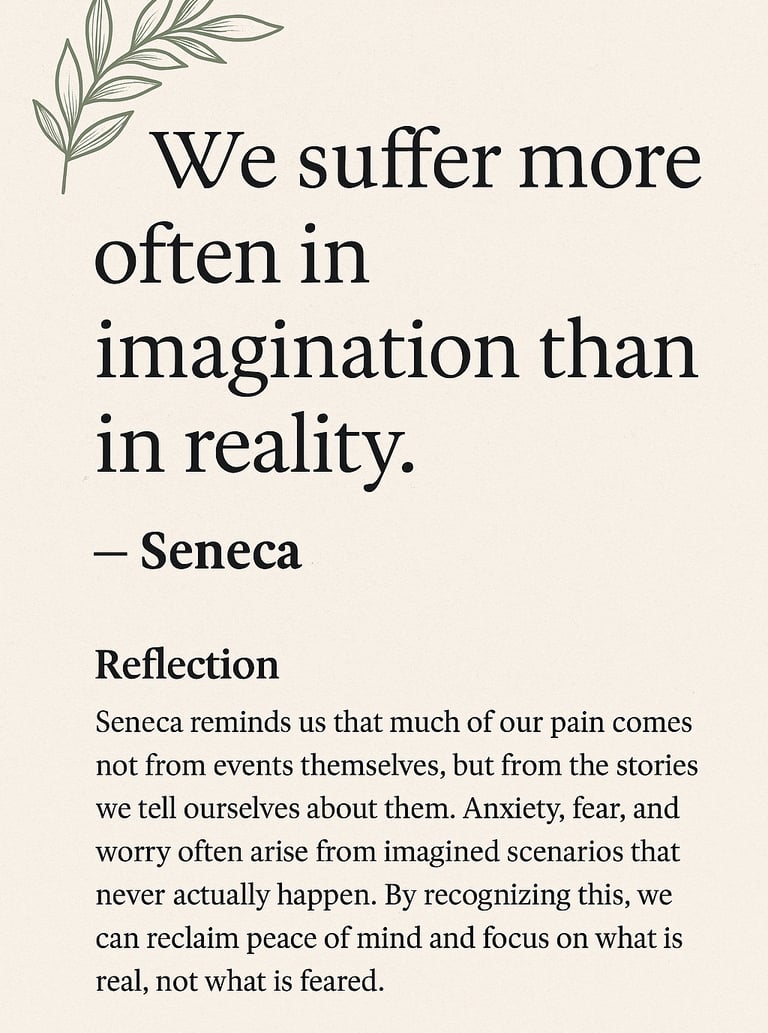
“We suffer more often in imagination than in reality.” — Seneca
Imagine your mind as a grand amphitheater. The stage is empty, yet the curtains rise and your thoughts begin to perform. They conjure scenes of rejection, failure, catastrophe—none of which have actually occurred. The audience (your nervous system) reacts as if the drama is real. Your heart races, your breath shortens, and your peace vanishes.
Seneca’s quote is a spotlight on this phenomenon. He’s not dismissing real suffering—he’s exposing the phantom pain we inflict on ourselves through anticipation, worry, and mental rehearsal of worst-case scenarios. It’s the difference between being hit by a storm and endlessly checking the weather app, convinced it’s coming.
Metaphor: The Phantom Director
Think of your imagination as a rogue director. It casts fear in every role, scripts disaster into every scene, and refuses to call “cut.” Seneca urges us to fire this director. Reality, by contrast, is a minimalist playwright—it deals only in what is, not what might be. The Stoic path is to become the discerning producer: choosing which scripts to fund and which to discard.
Stoic Tools for Modern Minds
Seneca’s wisdom isn’t just poetic—it’s practical. Here’s how we can apply his insight to daily life:
1. Practice Present-Moment Awareness
Technique: Use breathwork or grounding exercises to anchor yourself in the now.
Why it works: Anxiety thrives in the future. Presence dissolves its fuel.
Example: When your mind starts spinning “what if” scenarios, pause and name five things you can see, hear, or feel. This interrupts the imagination loop.
2. Journal Your Fears
Technique: Each morning, write down one fear. Then ask: Is this happening now? Is it based on evidence or imagination?
Why it works: Journaling externalizes the fear, making it easier to analyze and defuse.
Bonus: End with a Stoic affirmation like “I will meet reality with courage.”
3. Reframe Catastrophizing with Logic
Technique: Use the Stoic dichotomy of control. Ask: Is this within my control?
Why it works: It shifts focus from helplessness to action.
Example: Instead of “What if I fail the interview?” try “I can prepare thoroughly and show up with clarity.”
🛡 4. Voluntary Discomfort
Technique: Occasionally choose minor discomforts (cold showers, skipping a luxury).
Why it works: It trains the mind to face reality without fear.
Seneca’s version: He advised dressing simply and eating modestly to remind himself that he could endure hardship.
5. Mental Rehearsal with a Twist
Technique: Instead of imagining disaster, rehearse resilience.
Why it works: It builds confidence and emotional immunity.
Example: Visualize yourself calmly handling a challenge, not panicking over it.
From Thought to Action: A Daily Stoic Routine
Here’s a sample morning ritual inspired by Seneca:
Morning Mindset
Read one Stoic quote.
Journal one fear and reframe it.
Practice 3 minutes of breathwork.
Evening Reflection
Ask: Did I suffer today from imagination or reality?
Note one moment where you chose presence over panic.
Write a gratitude line: “I am grateful for the clarity to see what is.”
Final Thought
Seneca’s quote is not just a warning—it’s an invitation. An invitation to step off the mental stage, close the curtains on imagined suffering, and walk into the quiet clarity of reality. When we do, we find that life is lighter than our fears, and peace is closer than we think.
Let this be your weekly anchor. And remember: the mind is a powerful storyteller. Choose your scripts wisely.

Do you have a life changing story and want to help others with your experience and inspiration. Please DM me or Send me an email at the links below
Contact Me
© 2025. All rights reserved.
Privacy Policy