"I Survived. I Lived. Then I Woke Up."

The Zephyr Guide to Emotional Avoidance
Stop calling yourself lazy. Discover why procrastination is actually emotional avoidance and how to fix it using Zephyr's "Honesty Method" to regain control.
Chritopher J
1/21/20265 min read
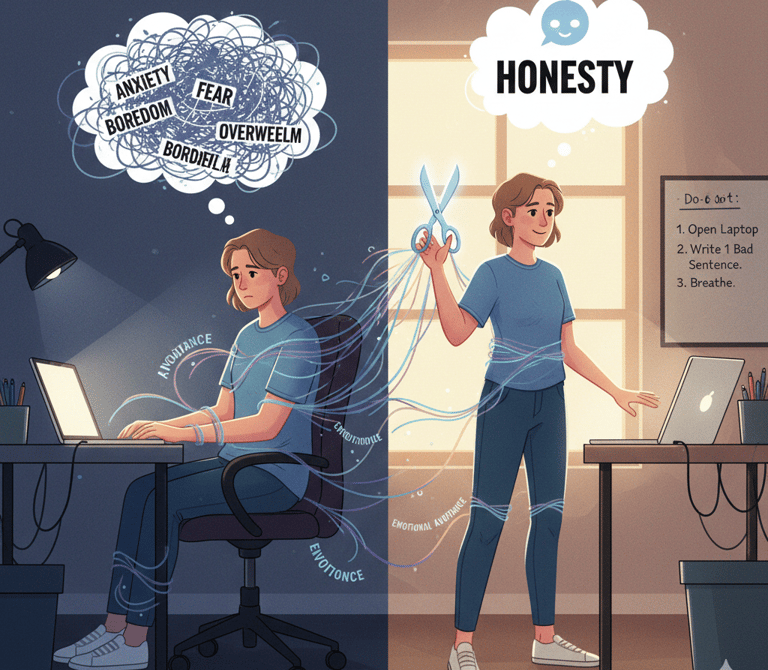
Procrastination is Not Laziness (And Other Truths Zephyr Taught Me About My Brain)
It is 10:00 AM. You sit down to write that important report.
It is now 10:15 AM. You are currently researching the history of the spork on Wikipedia. You have also reorganized your desktop icons by color.
We have all been there. We label ourselves "lazy," "unfocused," or "disorganized." We buy planners we never use and download productivity apps that just become another thing to ignore. But according to Zephyr, the voice of reason we often ignore, we are diagnosing the problem completely wrong.
You aren't lazy. You are just having feelings you don't want to feel.
Today, we are diving into Zephyr’s notes on Emotional Avoidance—the real reason you push things off—and how to finally break the cycle without hating yourself in the process.
The Great Lie: "I'll Do It Later"
Zephyr drops a hard truth right out of the gate: Procrastination is not a time management issue. It is an emotion management issue.
When you look at that big, scary task (let's call it "The Thing"), your brain doesn't see a to-do list item. It sees a threat. It anticipates boredom, anxiety, insecurity, or frustration. Your brain, which is designed to keep you safe and happy, says: "Hey! That Thing makes us feel bad. You know what makes us feel good? scrolling TikTok or eating cheese. Let's do that instead."
This is Emotional Avoidance. You aren't avoiding the task; you are avoiding the feeling that comes with the task.
The Adrenaline Trap
Some of us claim we "work better under pressure." Zephyr calls bluff on this.
What actually happens is that we delay until the fear of not doing the task outweighs the fear of doing it. We wait until the deadline is so close that we get a massive cortisol and adrenaline spike. That rush forces us to focus, but it’s a dirty fuel. It burns you out, spikes your anxiety, and leaves you exhausted. It’s not a strategy; it’s a panic response.
The Zephyr Method: Radical Honesty
So, how do we stop running away from our own feelings? The way out, Zephyr argues, is Honesty.
You have to stop asking, "Why am I so lazy?" and start asking the right question: "What emotion am I trying not to feel right now?"
Is it:
Fear? (I'm afraid I'll do a bad job.)
Boredom? (This spreadsheet is mind-numbing.)
Resentment? (I shouldn't have to do this.)
Overwhelm? (I don't know where to start.)
Once you name the monster, it shrinks.
The "What If" Game (The Good Kind)
Anxiety thrives in the vague. We procrastinate because we have a catastrophic, blurry idea of how hard the task will be. Zephyr suggests getting specific:
What exactly do I think will happen?
Example: "I think I will write this email, it will sound stupid, and my boss will think I'm incompetent."
If that happens, what will I do?
Example: "If the email isn't great, I will edit it. If my boss has feedback, I will learn from it. I will not die."
By answering these, your sense of control returns. You realize the "threat" is manageable.
Waiting vs. Procrastinating: The Guilt Test
Not all delay is bad. Sometimes, waiting is smart. Sometimes you need more information or energy. But how do you tell the difference between "Strategic Delay" and "Panic Procrastination"?
Zephyr offers a simple litmus test: How do you feel while you are waiting?
Strategic Delay: You feel calm, prepared, and intentional. You are gathering resources.
Procrastination: You feel guilty, anxious, and heavy. You are running away.
If there is guilt attached to the waiting, it’s emotional avoidance.
Strategies to Hack Your Brain
You can’t just "willpower" your way out of emotional avoidance. You need tactics. Here are Zephyr’s top plays for overcoming the freeze.
1. The Trade-Off List
Your brain thinks avoiding the task is a "win" because you get immediate relief. You need to show it the data. Write it down:
If I Stop (Procrastinate): I get immediate relief, but I gain stress, guilt, and a ruined weekend.
If I Act: I get immediate discomfort, but I gain freedom, peace, and reclaimed energy.
Make the cost of inaction visible.
2. Friction vs. Flow
We usually make the "escape routes" (phone, TV, snacks) too easy and the "work" too hard. Flip the script.
Build Friction Against Escape: Put your phone in another room. Use a website blocker. Make it annoying to procrastinate.
Demand Less of the Work: Zephyr notes, "If you demand excellence on the first step, you'll never do the first step."
Don't try to "Write the Essay."
Just "Open the Laptop."
Then "Write one bad sentence."
3. Change the Pattern
Ask yourself: "Do I actually want to change this?" Sometimes we keep procrastinating because we get a weird payoff from being the "victim" of our own schedule. We get to complain about how busy we are. Radical ownership means admitting you are choosing your suffering.
4. Talk to Yourself Like Someone You Love
This is the FITIQ golden rule. If your best friend was struggling to start a workout, would you scream, "YOU LAZY FAILURE, DO IT NOW!"? No. You’d say, "Hey, just do 10 minutes. You got this. It’ll feel good to be done."
Self-criticism drains the energy you need to work. Self-compassion refills the tank.
Clarity is the Antidote
Finally, Zephyr reminds us: "You can't do everything."
Part of the overwhelm comes from trying to do it all at once. Clarity reduces procrastination.
Decide what is a priority.
Decide what is not.
Make the task smaller and clearer.
"Get in shape" is terrifying. "Put on running shoes" is easy. "Write book" is impossible. "Write 200 words" is a lunch break.
The next time you feel that urge to run away, stop. Take a breath. Ask yourself what you are feeling. Then, be brave enough to do just one small, imperfect thing.
Key Takeaways
It’s Not Laziness: Procrastination is an emotional strategy your brain uses to avoid feelings like fear, boredom, or anxiety.
The Honesty Hack: The way out is to ask, "What emotion am I trying not to feel?" and address that feeling directly.
The Guilt Test: If delaying makes you feel prepared, it’s strategy. If it makes you feel guilty, it’s procrastination.
Lower the Bar: Demanding excellence on step one guarantees you will never take step one. Aim for "done," not "perfect."
Create Friction: Make your distractions hard to reach and your work easy to start.
Self-Compassion: Talk to yourself like a friend. Guilt drains the battery you need to get the job done.
FAQ: Procrastination and Emotional Regulation
Q: I feel like I work better under pressure. Is that really bad? A: Zephyr argues that while the adrenaline rush works sometimes, it’s unsustainable. It relies on cortisol (stress), which leads to burnout and lower quality work over time. You are training your brain to only work when it's in "panic mode."
Q: How do I make a task "smaller" if it's actually a huge project? A: Break it down until the first step is laughably easy. If "Clean the Garage" is too big, the step is "Walk into the garage." If that's too big, the step is "Put on shoes." Lower the barrier until you can’t say no.
Q: What if the emotion I'm avoiding is just boredom? A: Boredom is painful for the brain! Acknowledge it. "This is boring, and that’s okay." Then, pair the task with something you like (music, a podcast, a nice coffee) or use the Pomodoro technique to sprint through the boredom in short bursts.
Q: Why does Zephyr say "Clarity reduces procrastination"? A: Ambiguity breeds anxiety. If you don't know exactly what the next step is, your brain treats the task as a threat. Defining the specific next action removes the guesswork and lowers the emotional barrier.
Q: Can perfectionism cause procrastination? A: Absolutely. Perfectionism is just fear in fancy shoes. If you are afraid you won't do it perfectly, you won't do it at all. Give yourself permission to do a "C-" job just to get started.

Do you have a life changing story and want to help others with your experience and inspiration. Please DM me or Send me an email at the links below
Contact Me
© 2025. All rights reserved.
Privacy Policy