"I Survived. I Lived. Then I Woke Up."

The Performance Paradox: Why Pushing Through is Killing Your Progress | FiT iQ
Discover why "hustle culture" is biological sabotage. Learn the science of recovery and how to build sustainable progress from my own personal journey
Christopher J
2/6/20265 min read

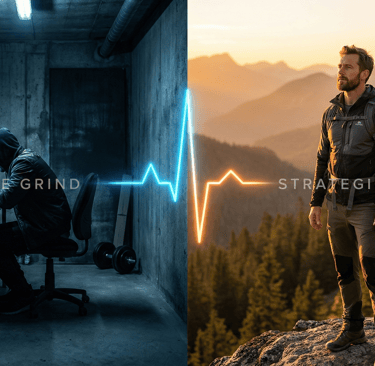
The Performance Paradox: Why “Pushing Through” is Killing Your Progress
In the modern landscape of high-performance culture, we have been sold a dangerous lie: that the person who sleeps the least and suffers the most wins. We celebrate the "grind," the "hustle," and the relentless "push through at all costs" mindset as the ultimate badges of honor. We look at burnout not as a warning light on the dashboard, but as proof that we’re actually trying
I used to believe that lie, too. At 30, I lived inside a body that felt unbreakable—quiet rhythms, steady breath, no hint of the storm gathering beneath the surface. But biology has its own truth, and it doesn’t whisper. It collapses. It takes you under. I woke 55 days later, tethered to life by tubes and monitors, learning the hard way that even the strongest bodies have thresholds.
From a biological and psychological standpoint, the "push through" mindset is not a strategy—it is a race to the bottom. When you treat your body and mind like a lemon to be squeezed for every last drop of productivity, you eventually run out of juice. Sustainable progress is not built on constant overexertion; it is built on the strategic integration of intensity and recovery.
1. The Biology of Burnout: Why Your Body Doesn't Negotiate
The "push through" mindset operates on the assumption that the human body is a linear machine. It is not. It is a complex, adaptive biological system governed by the General Adaptation Syndrome (GAS).
When you train or work at high intensity, you enter the "Alarm" phase. Your body then enters "Resistance," where it adapts to the stressor to become stronger. However, if you do not allow for recovery, you skip the "Supercompensation" phase and plummet straight into "Exhaustion."
The Central Nervous System (CNS) Debt While your muscles might feel ready for another set, your Central Nervous System may still be in debt. CNS fatigue is systemic. When you overreach constantly, your sympathetic nervous system (fight or flight) remains chronically active. This leads to:
Elevated Cortisol: Chronic high cortisol inhibits muscle protein synthesis and promotes fat storage.
Decreased Testosterone: The body deprioritizes reproductive and growth hormones in favor of survival hormones.
Reduced Motor Unit Recruitment: You physically cannot exert as much force, making your "hustle" sessions significantly less effective than a rested session.
2. When the Body Picks Your Rest Day for You
If you don't pick a day to rest, your body will eventually pick a month to be sick—or in my case, 76 days in the ICU. I spent 55 of those days in a coma. I woke up to a reality where I had three chest tubes draining my lungs, a tracheostomy tube in my neck, and a PEG feeding tube in my stomach.
While I was "pushing" in my mind, my body was enduring:
Atrial Fibrillation (three times).
Sepsis (twice).
Collapsed Lungs.
Rhabdomyolysis.
I went from a solid 194 lbs to a skeletal 104 lbs. I was paralyzed and had to relearn how to stand on my own two feet. The doctors said I’d never live a normal life again, that I’d need oxygen forever, and that I had permanent pulmonary fibrosis. But I refused to believe it. My recovery wasn't just physical; it was mental warfare.
3. The Psychology of the "Burnout Loop"
The "push through" mindset is often driven by Urgency Bias—the feeling that every task or workout is a Level 10 emergency. Psychologically, this creates a state of chronic anxiety that undermines cognitive performance.
"To anyone facing adversity, I offer this: You are not defined by your experiences, but by how you respond to them.
.The Yerkes-Dodson Law
According to this psychological principle, performance increases with physiological or mental arousal, but only up to a point. When levels of arousal become too high—due to chronic stress or "hustle"—performance decreases significantly. By refusing to rest, you are operating on the "downward slope" of the curve, where more effort leads to poorer results.
Furthermore, tying your self-worth exclusively to "doing" rather than "being" creates a fragile identity. When you inevitably crash—which the body will eventually force you to do—the psychological fallout can be devastating, leading to deep-seated feelings of failure and stagnation. I could have let the pain consume me, but I chose resilience.
4. The Recovery Revolution: Recovery is the Work
To achieve better long-term results, we must reframe recovery not as "quitting" or "being lazy," but as an active component of performance.
Strategies for Sustainable Progress
The 80/20 Rule of Intensity: Aim for 80% of your efforts to be at a sustainable, moderate intensity, leaving only 20% for true "high-intensity" pushes.
Strategic Deloading: Every 4–6 weeks, intentionally reduce your volume and intensity by 30–50% to allow the CNS to fully reset.
Sleep Hygiene: Sleep is the most powerful performance enhancer in existence. A 12-minute micro-workout on 8 hours of sleep is significantly more effective for metabolic health than a 60-minute session on 4 hours of sleep.
Active Rest: Engaging in low-impact movement (walking, mobility flows) stimulates blood flow without adding to the systemic stress load.
5. Merging Human Resilience with Modern Science
My comeback was fueled by my background in fitness, nutrition, and psychology. I built my own rehabilitation plan, walking on a treadmill with a portable oxygen tank strapped to my back. Twenty-four months later, my "permanent" fibrosis was gone, I ditched the oxygen tank, and I was back to a healthy 198 lbs.
Today, my lung function has climbed from 13% to 51%. This is why I started FiT iQ—to share life-changing tech and health science breakthroughs, often with the help of AI. Whether it’s a new supplement, a recovery wearable, or an AI-driven training platform, I ask one question: "Will this save someone's life or have an impact on quality of life?".
6. The Long Game: Consistency vs. Intensity
Hustle culture prioritizes intensity—how hard you can go today. Sustainable performance prioritizes consistency—how many "todays" you can show up for.
The person who trains at 70% intensity for five years will always outperform the person who trains at 110% for three months and then spends six months sidelined by injury or burnout. True tenacity is not about the one-time explosion of effort; it is about the quiet, disciplined decision to rest so that you can show up again tomorrow. Never surrender to the voice of doubt, but learn to listen to the voice of your body.
Key Takeaways
Recovery is Mandatory: Your body does not negotiate with your schedule.
Hustle is a Diminishing Return: Operating in chronic stress reduces your biological and cognitive output.
Supercompensation: Growth only happens during the rest phase. No rest = no growth.
CNS Management: Understand that mental stress and physical stress come from the same "pool." You cannot max out both indefinitely.
FAQs
Q: Does "Anti-Hustle" mean I should never push myself? A: No. It means you should push yourself with intent. High effort is a tool to be used sparingly and strategically, not a permanent state of existence.
Q: How do I know if I’m being lazy or if I actually need a rest day? A: Check your "Action IQ." If you are avoiding a task because of fear, that is emotional avoidance. If you are avoiding it because you feel physically heavy or lack "mental snap," that is a recovery requirement.
Q: Won't I lose my progress if I take a deload week? A: Biologically, it takes nearly 3 weeks of total inactivity to begin losing significant muscle mass. A one-week reduction in intensity actually primes the body for a new wave of progress.
Q: How can I deal with the guilt of resting? A: Reframe it. Tell yourself: "I am not resting; I am actively facilitating the adaptation from my previous work." Rest is a high-level performance choice.
Do you have a life changing story and want to help others with your experience and inspiration. Please DM me or Send me an email at the links below
Contact Me
© 2025. All rights reserved.
Privacy Policy