"I Survived. I Lived. Then I Woke Up."

Muscle Function Over Muscle Size: The Ghrelin Receptor Secret to Aging Strong
Discover how blocking the hunger hormone receptor enhances mitochondrial health and muscle endurance. Learn why functional strength is the true secret to aging well.
Christopher J
6 min read
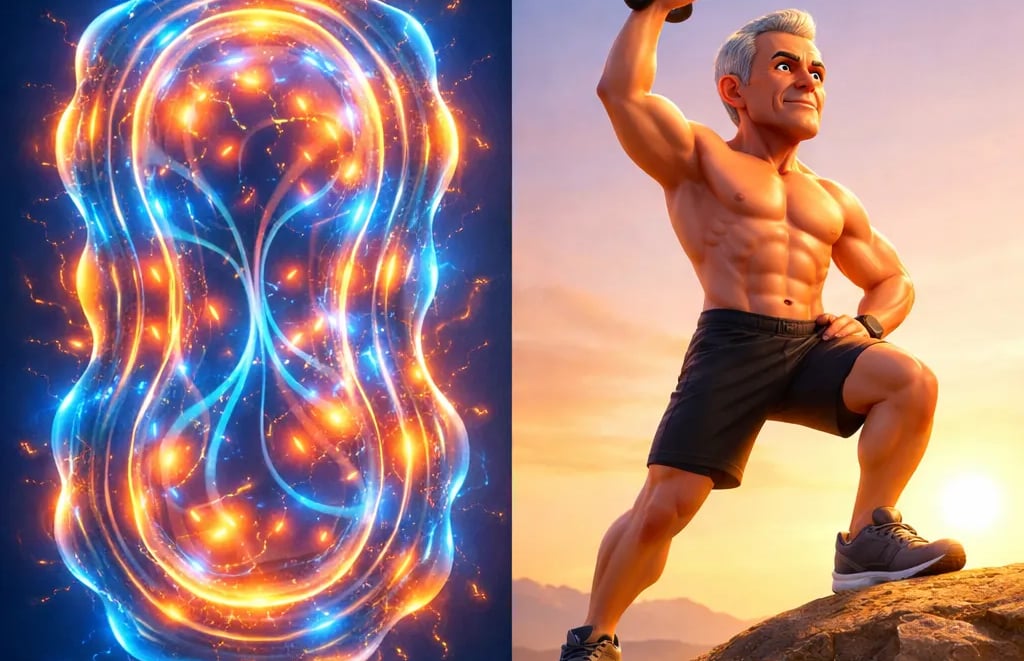
Introduction: The FiTiQ Origin and the Modular Strength Paradigm
To fully grasp the profound paradigm shift from aesthetic muscle size to functional metabolic endurance, one must first understand the origins of the FiTiQ “modular strength” philosophy. The founder of FiTiQ didn’t discover this concept in a gerontology textbook; he was forced to build it from the ashes of a complete physiological collapse.
At 30 years old, what began as a picturesque engagement in Key West rapidly descended into a 55-day medically induced coma brought on by a severe COVID-19 Delta variant infection. He endured 76 days in the Intensive Care Unit, battling multiple bouts of sepsis, collapsed lungs, atrial fibrillation, and rhabdomyolysis. His body was ravaged, plummeting from a muscular 194 pounds down to a paralyzed, skeletal 114 pounds.
Defying grim medical prognoses of permanent oxygen dependency and lifelong round-the-clock care, he utilized his extensive background in fitness and psychology to architect a relentless, self-designed rehabilitation protocol. Twenty-four months later, completely recovered, free from the oxygen tank, and back to a healthy 198 pounds, his journey forged a non-negotiable truth: true strength is modular, metabolic, and functional. When pushed to the absolute brink, it is not the size of the muscle that saves a life, but the relentless efficiency of the cellular engine.Defying grim medical prognoses of permanent oxygen dependency and lifelong round-the-clock care, he utilized his extensive background in fitness and psychology to architect a relentless, self-designed rehabilitation protocol.
1,095 later, he was free from the oxygen tank, and back to a healthy 198 pounds, his journey forged a non-negotiable truth: true strength is modular, metabolic, and functional. When pushed to the absolute brink, it is not the size of the muscle that saves a life, but the relentless efficiency of the cellular engine.
It is through this lens of extreme, real-world survival that he now breaks down the monumental implications of the latest ghrelin receptor research, asking the single most important question in fitness: “Will this save someone’s life or have an impact on quality of life?”.
Muscle Function Over Muscle Size: The Secret to Aging Strong
The mirror is a masterful, unapologetic liar. For decades, fitness culture has conditioned individuals to believe that strength is intrinsically linked to size. The pursuit of biceps resembling small boulders and quadriceps that require custom-tailored denim might look fantastic under the engineered lighting of a commercial gym. However, when it comes to the brutal, unforgiving reality of human aging, the biological accounting department cares absolutely nothing about aesthetics. It cares only about function, endurance, and cellular survival.
Sarcopenia, the medical term for the age-related loss of muscle mass and strength, is a quiet global crisis that gradually strips older adults of their independence. Starting around age 30, people can lose up to 2% of their muscle function each year. their 80s, nearly half will experience severe sarcopenia, increasing the risk of dangerous falls, frailty, and long hospital stays. This condition costs healthcare systems billions annually, and for years, scientists have sought a pill to halt the decline, often focusing on ways to build bigger muscles.
Recently, an extraordinary breakthrough published in the prestigious journal Aging Cell turned the entire concept of strength upside down.
The secret involves a molecule called ghrelin. In popular culture, ghrelin is infamous as the “hangry” hormone (the chemical signal that makes individuals crave refined carbohydrates at midnight).
Ghrelin acts on a specific cellular lock called the GHSR-1a receptor. As organisms age, their natural ghrelin levels increase. While this sounds like a good way to maintain appetite, it brings along unwanted metabolic baggage, correlating directly with fat accumulation and rapid muscle fatigue.
Researchers at the VA Puget Sound Health Care System and the University of Washington decided to see what would happen if they chemically evicted ghrelin from the premises. They engineered a group of mice that entirely lacked this receptor and compared them to normal mice as they aged into the rodent equivalent of senior citizens.
In a twist that sounds delightfully counterintuitive to gym-goers everywhere, the mice lacking the growth hormone receptor did not turn into massive, hulking beasts. In fact, they were physically smaller and lighter than the normal mice. But when placed on a treadmill, these smaller mice became the undisputed, pound-for-pound champions of endurance. They were the marathoners of the laboratory. At two years of age, they could run 30% longer than normal mice. A few months later, that gap widened to an astonishing 45%. Furthermore, when their muscles were electrically stimulated to induce exhaustion, the smaller muscles refused to quit.
How does a smaller muscle outwork a visibly larger one? The secret lies in cellular housekeeping.
The endurance of a muscle is entirely dependent on its mitochondria (powerhouse of the cell) .Like a fleet of cars, mitochondria eventually break down, leak toxic exhaust, and lose their efficiency. The mice lacking the ghrelin receptor were exceptionally gifted at a process called mitophagy. Mitophagy is the cellular equivalent of a highly efficient scrap yard. It identifies the broken, high-mileage mitochondria, breaks them down, and clears them out. This rapid demolition triggers a twin process called mitochondrial biogenesis, signaling the body to build brand-new, ultra-efficient power plants from scratch.
By constantly refreshing the fleet, the smaller muscles operated with pristine, tireless energy. They traded bulk for unbreakable stamina.
Because genetically engineering humans to lack hormone receptors is generally frowned upon by medical ethics boards, the researchers tested an experimental oral drug called PF-5190457. Originally developed by Pfizer to help curb alcohol cravings by blocking reward pathways in the brain, this drug operates as a highly specific “inverse agonist.”
When researchers administered PF-5190457 to middle-aged and elderly normal mice for just 28 days, the results were stunningly identical to the genetic anomaly. The drug forced the aging mice into peak mitochondrial housekeeping. The animals lost excess visceral fat (thanks to the drug silencing their appetite), built new mitochondria, cleared out the damaged cellular junk, and significantly boosted their running endurance.
While PF-5190457 did not magically extend the absolute lifespan of the mice—proving the mythical Fountain of Youth remains elusive for now—it drastically improved their “healthspan.” They remained highly functional, active, and independent right up to the end of their natural lives.
The implications for human fitness are clear and profound. A modular approach to strength—one that prioritizes cardiovascular efficiency, mitochondrial health, and fatigue resistance over sheer muscle volume—aligns perfectly with the absolute cutting-edge of longevity science. Pumping heavy iron will always have its place, but building a metabolic engine capable of clearing out its own cellular junk is the ultimate evolutionary flex. Function will always outlast size.
Key Takeaways
Redefining Strength: The clinical definition of strength in aging is shifting; muscle endurance, metabolic flexibility, and fatigue resistance are far more critical to maintaining independence than sheer aesthetic muscle mass.
The Sarcopenia Threat: Age-related muscle loss affects up to 50% of octogenarians, severely increasing the risk of falls, frailty, and mortality. Despite costing healthcare systems billions, no approved drug therapies currently exist.
The Ghrelin Paradox: Inhibiting the GHSR-1a receptor (the “hunger hormone” sensor) in aged mice dramatically improves treadmill running time by up to 45%, making the muscles significantly stronger pound-for-pound despite a smaller overall mass.
Cellular Housekeeping: The vast endurance improvements are driven by enhanced mitophagy (clearing out damaged, toxic mitochondria) and mitochondrial biogenesis.
The Promise of PF-5190457: An oral drug, originally tested safely in humans for alcohol use disorder, successfully mimicked these longevity benefits in mice. It reduced adiposity and boosted mitochondrial health, highlighting a massive potential future therapy for human physical decline.
Frequently Asked Questions (FAQs)
What exactly is sarcopenia, and when does it start?
Sarcopenia is the progressive, age-related loss of skeletal muscle mass, strength, and overall physical function. Starting around age 30, human beings naturally begin to lose between 1% and 2% of their muscle mass annually. By the time individuals reach their 80s, this cumulative loss can lead to severe physical disability, a loss of independence, and increased mortality.Why does blocking a “growth” hormone receptor make muscles stronger?
While the ghrelin receptor (GHSR-1a) promotes appetite and anabolism during youth, its chronic activation in older age correlates with metabolic dysfunction and fat accumulation. Blocking this receptor forces the muscle cells to prioritize efficiency and “housekeeping.” Specifically, it triggers the clearing out of damaged mitochondria and the building of new ones, resulting in massive gains in endurance and pound-for-pound strength rather than sheer size.What is the difference between mitophagy and mitochondrial biogenesis?
Mitochondria are the power plants of the cell. Mitophagy is the body’s selective recycling process, actively breaking down old, damaged, and inefficient mitochondria that leak toxic byproducts. Mitochondrial biogenesis is the subsequent creation of brand-new, highly efficient mitochondria. Together, this coupled process (mitohormesis) ensures the muscle always has a pristine, powerful energy supply.Is the drug PF-5190457 available for humans right now?
PF-5190457 is currently an experimental clinical candidate. While it has been profiled safely in humans during early-stage trials (primarily for alcohol use disorder and binge eating, where it effectively reduced cue-induced cravings), it is not yet approved by regulatory bodies or available on the market for the treatment of sarcopenia.How can the “modular strength” concept be applied to daily life today?
While waiting for pharmacological breakthroughs like PF-5190457, the underlying biological principles remain entirely actionable. Adopting a modular strength routine that prioritizes cardiovascular endurance, functional resistance training, and metabolic health naturally supports mitochondrial function. Evaluating fitness goals based on real-world function and stamina, rather than aesthetic size, is the most scientifically sound way to ward off the effects of sarcopenia.
Call to Action
The science of aging and physiological recovery is evolving faster than ever, proving definitively that true resilience is built from the inside out. Are you prioritizing the health of your cellular engine, or just the reflection in the mirror? Do not let the science of longevity pass by unutilized. Subscribe to the FiT iQ newsletter today for the latest breakthroughs in biotechnology, exclusive deep-dives into human resilience, and actionable strategies to build modular, functional strength that lasts a lifetime. Leave a comment below with your thoughts on the functional strength revolution and how you plan to upgrade your metabolic engine!

Do you have a life changing story and want to help others with your experience and inspiration. Please DM me or Send me an email at the links below
Contact Me
© 2025. All rights reserved.
Privacy Policy