"I Survived. I Lived. Then I Woke Up."
Marcus Aurelius on Mornings: Why Duty Beats Motivation Every Time
Struggle to get out of bed? You're not alone. Marcus Aurelius fought the same battle. Learn how the "Philosopher of Duty" can help you conquer the morning and embody the FITIQ mindset
Chritopher Bonelli
1/8/20268 min read
The Emperor Who Hated Mornings: Why Marcus Aurelius is the Ultimate Gym Partner
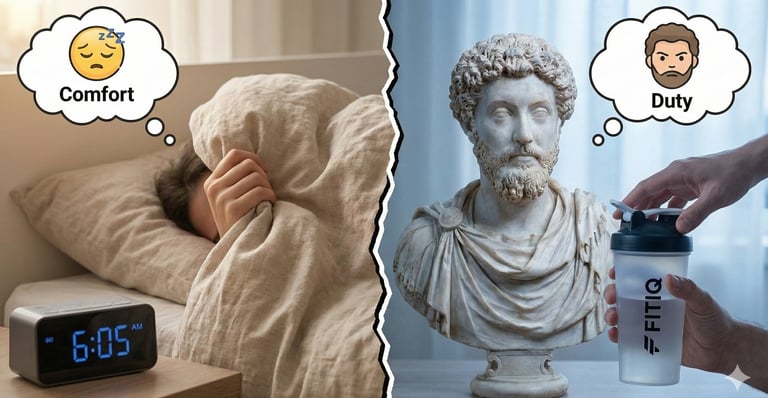
The alarm goes off.
It is 6:00 AM. The room is dark. The floor is cold. Your bed, on the other hand, is a warm, marshmallow-fluff cloud of happiness. It is the most comfortable place in the known universe. Outside that duvet lies a world of deadlines, traffic, burpees, and emails that could have been meetings.
Your brain begins the negotiation. You know the one. "If I skip the workout, I can sleep for 45 more minutes. I’ll just go tomorrow. Actually, rest is important for recovery. I’m being responsible by sleeping in. Yes, good job, me."
We have all been there. We have all lost that negotiation.
But here is a comforting thought: Even the most powerful man in the world struggled to get his butt out of bed.
Marcus Aurelius wasn't just a philosopher; he was the Emperor of Rome. He didn't have a boss. He didn't have to clock in. If he wanted to stay in bed until noon eating grapes while servants fanned him, literally no one could stop him. Yet, nearly 2,000 years ago, he lay in bed having the exact same argument with himself that you had this morning.
And he won that argument with a single, brutal concept: Duty.
At FITIQ, we talk a lot about Tenacity and Quality of Life. But neither of those exist without the starting line. Today, we are channeling the "Philosopher of Duty" to figure out how to stop waiting for motivation and start doing the work—simply because we were designed to do it.
The Quote That Slaps You in the Face
In his personal journal (which we now know as Meditations), Marcus wrote a pep talk to himself that destroys every excuse we have ever made.
"At dawn, when you have trouble getting out of bed, tell yourself: 'I have to go to work — as a human being. What do I have to complain of, if I’m going to do what I was born for — the things I was brought into the world to do? Or is this what I was created for? To huddle under the blankets and stay warm?'"
It continues with his brain fighting back (sounding remarkably like us):
"But it’s nicer here..."
And Marcus replies:
"So you were born to feel 'nice'? Instead of doing things and experiencing them? Don’t you see the plants, the birds, the ants and spiders and bees going about their individual tasks, putting the world in order, as best they can? And you’re not willing to do your job as a human being?"
Ouch.
Marcus Aurelius basically called himself out for being lazier than a bee. But this isn't just about guilt-tripping yourself; it is a profound shift in mindset from Feeling to Function.
The Great Lie: "I Don't Feel Like It"
We live in a culture that worships feelings. We are told to "listen to our bodies" (which is valid for injury, but often used as an excuse for laziness) and to "follow our passion." We treat motivation like it is a prerequisite for action.
I’ll go to the gym when I feel energetic.
I’ll start the diet when I feel ready.
I’ll write that report when I feel inspired.
Here is the hard truth that Stoicism teaches: Motivation is a feeling, and feelings are fickle liars.
Motivation is like a flakey friend who says they’ll help you move house, but then ghosts you on the day of because it’s raining. If you build your life—your fitness, your career, your relationships—on the foundation of "feeling like it," you are building on sand.
Marcus Aurelius didn't "feel" like dealing with the Germanic tribes invading the border. He didn't "feel" like managing a plague. He didn't "feel" like getting out of his warm imperial bed.
He did it anyway because he shifted his operating system from Motivation to Duty.
Duty doesn't care if you are tired. Duty doesn't care if it's raining. Duty is binary. Is this your job as a human being? Yes? Then the feelings are irrelevant.
What is Your "Job as a Human Being"?
Marcus asks, "Is this what I was created for? To huddle under the blankets?"
Biologically, the answer is a hard no.
Your body is an engineering marvel designed for movement. You have 600+ muscles, a cardiovascular system capable of incredible endurance, and a brain that thrives on problem-solving. When you are sedentary, when you choose the easy path, you are quite literally operating against your design specs.
Think about the FITIQ pillars:
Fitness: Not just looking good in a mirror, but having a body that functions at its peak.
Tenacity: The mental grit to endure discomfort.
Inspiration: Being a beacon for others.
Quality of Life: The result of the previous three.
When you hit snooze, you aren't just missing a workout. You are denying your nature. You are choosing to be a "huddler" rather than a "hunter."
The bees are working. The ants are working. The sun is up. The universe is moving. Who are we to claim that we are the only thing in existence that gets a pass because the floor is chilly?
Re-Framing the "Grind"
The word "Duty" sounds heavy. It sounds like chores. It sounds like eating boiled broccoli.
But Marcus flips this perspective. He suggests that doing your work isn't a punishment; it is a privilege. It is an expression of self-love.
If you bought a Ferrari and left it in the garage under a tarp for 10 years, that wouldn't be "protecting" the car. That would be ruining it. A Ferrari is designed to drive. It is happiest (mechanically speaking) when it is doing what it was built to do.
You are the Ferrari.
Training, working, creating, solving—this is you taking the tarp off. It is you fulfilling your potential. When you view your morning workout not as a "chore I have to do to lose weight" but as "the necessary maintenance of a high-performance machine," the resistance fades.
It stops being about willpower and starts being about identity.
I don't struggle to brush my teeth. I just do it. It’s who I am.
I don't struggle to feed my dog. I just do it. It’s my duty.
I don't struggle to train. I just do it. It’s my nature.
How to Apply "The Marcus Method" Tomorrow Morning
Okay, the philosophy is great. But tomorrow morning, at 6:00 AM, you are going to be tired again. How do we take this ancient wisdom and make it practical?
1. The "Human Being" Check
When the alarm goes off and your brain offers the excuse ("It's too cold"), counter it immediately with the Marcus question: "Am I a human being, or am I a blanket warmer?" Remind yourself that comfort is the enemy of growth. Comfort is a slow death. Action is life.
2. Remove the Choice
Duty isn't a choice; it's an obligation. Decide the night before that the decision has already been made. You don't decide to work out in the morning. You decided last night. Morning-You is just the employee executing the orders of Night-You (the CEO). Do not let the employee renegotiate the contract at 6:00 AM.
3. Amor Fati (Love the Fate)
The Stoics loved the concept of Amor Fati—loving whatever happens. Did you wake up with a headache? Good. It’s a chance to practice toughness. Is it raining? Good. It’s a chance to train in adverse conditions. Don't just tolerate the difficulty of waking up; embrace it. The friction is where the gem gets polished.
4. Connect to the Bigger Picture (FITIQ)
Marcus got up to serve Rome. You are getting up to serve your future self. Every rep, every healthy meal, every moment of focus is a vote for the person you want to become. You are building the FiTiQ brand within yourself. You are building resilience. You are building a vessel that can handle whatever life throws at it—whether that's a viral pandemic, a blood clot, or just a really stressful Tuesday.
The Cost of the Blankets
Let’s go back to the quote one last time. "Is this what I was created for? To huddle under the blankets and stay warm?"
Staying under the blankets feels good for about five minutes. But then what? Then comes the guilt. Then comes the stagnation. Then comes the slow erosion of your confidence because you broke a promise to yourself.
The cost of discipline is high, but the cost of regret is astronomical.
Marcus Aurelius ruled an empire, buried children, fought wars, and navigated plagues. He had every reason to stay in bed. He didn't. He got up. He went to work as a human being.
Tomorrow morning, the alarm is going to ring. The bed will be warm. The world will be demanding.
Don't negotiate. Don't wait for motivation. Get up. Do your job.
ey Takeaways
Motivation is a Myth: Waiting until you "feel like it" is a trap. Marcus Aurelius teaches that action should be driven by Duty, not temporary feelings.
The "Huddler" vs. The "Hunter": Humans are biologically engineered for movement and work. Staying sedentary (huddling under blankets) goes against your nature.
You Are the Ferrari: Duty isn't a punishment; it is the proper maintenance of a high-performance machine (you).
Night-CEO vs. Morning-Employee: Make the decision the night before. Do not allow your tired morning brain to renegotiate the terms of your goals.
The FITIQ Mindset: True tenacity is doing the work simply because it is your work to do, regardless of the temperature, the mood, or the comfort level.
FAQ: Stoicism, Mornings, and Motivation
Q: Is it really healthy to ignore my feelings? What if I'm actually exhausted? A: There is a difference between "fatigue" and "laziness." Stoicism isn't about ignoring biological needs (like recovery from illness or injury); it's about ignoring emotional resistance. If you have the flu, rest—that is your duty to your health. If you are just cozy and dreading the treadmill, that is resistance. Learn to tell the difference.
Q: How do I stop hitting snooze without thinking? A: Move the alarm. Put your phone or alarm clock across the room. Duty requires friction. If you have to physically get out of bed to turn off the noise, you have won the hardest part of the battle. Marcus didn't have a snooze button; don't let yourself have one either.
Q: Marcus Aurelius was an Emperor; isn't it easier to be disciplined when you are rich? A: Actually, it’s harder. When you have unlimited luxury, unlimited food, and servants to do everything, the temptation to be lazy is infinite. He had no external consequences for staying in bed. His discipline had to come entirely from within. That makes his struggle even more relatable.
Q: How does this relate to the FITIQ philosophy? A: FITIQ stands for Fitness, Tenacity, Inspiration, and Quality of Life. "Duty" is the engine of Tenacity. You cannot have a high Quality of Life if you are a slave to your impulses. By mastering your morning via Duty, you are embodying the core of the brand.
Q: I tried this and failed after 3 days. What now? A: You start again. Stoicism isn't about being perfect; it's about being persistent. Marcus wrote Meditations to himself because he needed the reminder constantly. If you fail, don't spiral into shame. Just acknowledge you huddled under the blankets, and resolve to do your job as a human being tomorrow.
Ready to Do Your Job?
You have the philosophy. You have the instruction manual. Now you need the community. Join the FITIQ tribe today for daily reminders that you were built for more than just staying warm. Let’s get to work—as human beings.
Do you have a life changing story and want to help others with your experience and inspiration. Please DM me or Send me an email at the links below
Contact Me
© 2025. All rights reserved.
Privacy Policy