"I Survived. I Lived. Then I Woke Up."
Intentional Discomfort: How to "Brain-Wash" Yourself for Resilience
A few posts ago i wrote about borrowing from our bank (Health bank) today I want to share how we DEPOSIT into our banks.
Christopher J
2/16/20265 min read
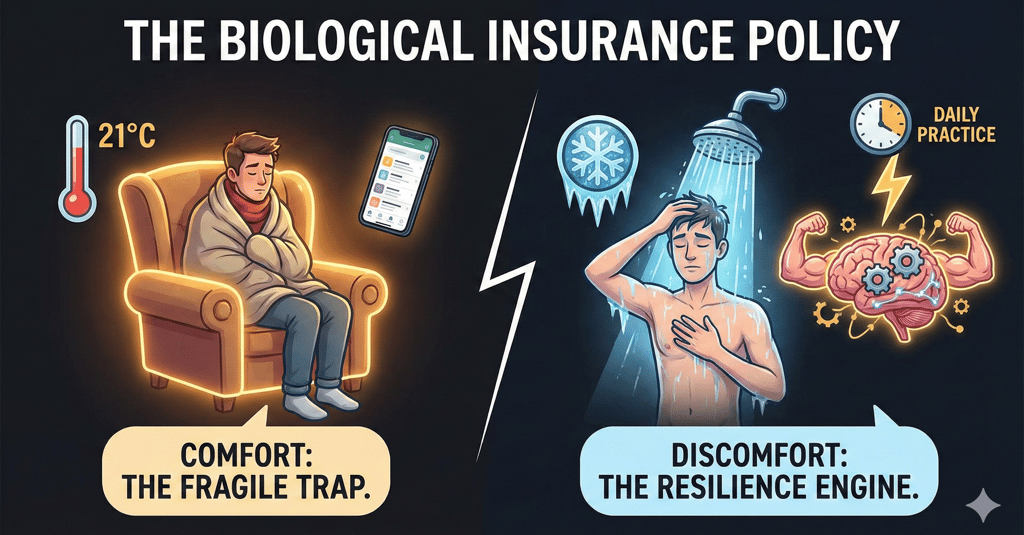
The Biological Insurance Policy: Why You Should Suffer on Purpose
We live in the era of the "Golden Handcuffs" of comfort.
If the room is slightly too warm, we touch a button to drop the temperature to exactly 21 degrees Celsius. If we are slightly hungry, a human on a scooter brings calories to our doorstep in 20 minutes. If we are bored, a supercomputer in our pocket provides a hit of dopamine designed by the world’s best engineers to keep us scrolling.
We have optimized the friction out of our lives. And in doing so, we have accidentally lobotomized our own resilience.
At FiTiQ, we talk about Tenacity as a core pillar. Tenacity is a muscle that you must tear and rebuild every single day through intentional discomfort.
Today, we are looking at why "suffering on purpose" is the only way to condition your brain to handle the stressors you didn't see coming.The word tenacity is derived from the Latin root tenax, meaning "holding fast" or "gripping." Its linguistic journey highlights a transition from physical gripping to the mental firmness we associate with the word today.In a Stoic framework—which values the internal fortitude of the individual—tenacity represents the practical application of Premeditatio Malorum (the contemplation of future evils). It is the mental "grip" one maintains on their principles and goals despite external resistance or hardship.
Today, we are looking at why "suffering on purpose" is the only way to condition your brain to handle the stressors you didn't see coming.
The Concept: Voluntary Hardship
The Stoics were the original bio-hackers. Long before we had cold plunges and fasted cardio, Seneca was advising his students to set aside a few days every month to live on the "scantiest and cheapest fare" and wear "coarse and rough dress".
He wasn't doing this because he was a masochist. He was doing it because he understood Voluntary Hardship.
The logic is simple: If you have already practiced being cold, hungry, and exhausted on your own terms, then when fate forces those conditions upon you, you don't panic. You don't have an emotional breakdown. You simply say, "Oh, I’ve been here before. This is just Tuesday."
In modern terms, this is about closing the gap between your Potential Rationality and your Actualized Rationality. It’s about ensuring that your "Inner Commentary" doesn't default to a Fixed Mindset when the floor drops out from under you.
The Science: Hormesis and the Stress Thermostat
Biologically, this process is known as Hormesis.
Hormesis is the phenomenon where a low dose of a stressor—something that would be toxic or lethal in high doses—actually makes an organism stronger and more resilient. Think of it like a "biological vaccine" for stress.
When you engage in intentional discomfort, you are effectively recalibrating your brain’s stress thermostat.
The Amygdala Check: Your amygdala is the "panic button" of your brain. It doesn't know the difference between a work deadline and a predator.
The Prefrontal Cortex (PFC) Integration: By choosing a 12-minute micro-workout when you are tired, or stepping into a cold shower, you are forcing your PFC (the logical brain) to override the amygdala’s "run away" signal.
Every time you stay in the discomfort for just 30 seconds longer than you want to, you are strengthening the neural pathways of Self-Regulation. You are teaching your brain that "unpleasant" does not mean "danger."
The Practice: Daily Deposits into the Bank of Resilience
You don't need to move into a cave to practice this. You just need to stop "huddling under the blankets" (both literally and metaphorically). Here is how we integrate intentional discomfort into the FiTiQ lifestyle:
1. The Cold Exposure
There is no better way to have a conversation with your amygdala than 15-degree Celsius water. When you hit that cold water, your brain screams "ABORT." Staying in for two minutes is a masterclass in Actualized Rationality. You are proving to yourself that your "Inner Commentary" is a liar.
2. The 12-Minute "Red Zone"
We advocate for micro-workouts because they are efficient, but they also offer a specific type of discomfort: intensity. Pushing your heart rate into the red zone for short bursts teaches your cardiovascular system—and your mind—how to handle "explosive" stress without panicking.
3. The Fasted State
Most of us eat before we are even hungry. Delaying your first meal by 4 hours isn't just about insulin sensitivity; it’s about proving that you are the master of your impulses, not their slave. It’s about moving from a "Fixed" view of your needs to a "Growth" view of your capabilities.
4. The Intellectual Friction
Read a book that challenges your worldview. Write code in a language you don't know yet. Engage in the "Adrenaline Trap" of a difficult conversation before it becomes a crisis. This is Tenacity for the mind.
Why "Reactive" Performance is the Goal
Life rarely gives you a 24-hour warning before a crisis. My pulmonary embolisms didn't book an appointment on my Google Calendar. The "unexpected stressor" is the true test of your character.
If you have never practiced discomfort, your "reactive" response to a crisis will be:
Panic: The amygdala takes total control.
Avoidance: You try to "dodge the feeling" of the stressor.
Fragility: You break under the weight because you have no "Hormetic" shield.
However, if you have been making daily deposits of discomfort, your "reactive" response becomes a Reflexive Response:
Clarity: Your PFC remains online. You think, "Okay, this is hard, but I’ve handled cold/hunger/fatigue before. What is the next logical step?".
Tenacity: You stay in the fight because your body is used to the "Red Zone."
Resilience: You view the obstacle as an opportunity to grow, not a limit to your abilities.
Key Takeaways
Comfort is a Trap: Living in a state of constant ease makes you fragile. Intentional discomfort is the antidote.
The Hormetic Effect: Small, controlled doses of stress (cold, exercise, fasting) make you biologically and psychologically stronger.
The Amygdala Override: Daily practice of discomfort strengthens the Prefrontal Cortex, allowing you to stay logical when life gets chaotic.
Reflexive Resilience: You don't "rise to the occasion" in a crisis; you "sink to the level of your training." Intentional discomfort is that training.
FiTiQ Integration: Use the 12-minute reset and Stoic principles to make daily deposits into your "Bank of Health".
FAQ: Purposeful Suffering
Q: Isn't this just unnecessary stress? I already have a stressful job. A: There is a difference between Chronic Stress (bad) and Hormetic Stress (good). Chronic stress is a loan you can’t pay back. Hormetic stress is an investment that pays dividends in resilience. By choosing your stress, you build the capacity to handle the stress you don't choose.
Q: How do I start without burning out? A: Start with the 3-Second Rule. When you feel the urge to seek comfort (like turning up the heat), wait 3 seconds. Then, do the harder thing. Lower the barrier: you don't need a 20-minute ice bath; start with 30 seconds of cold water at the end of your shower.
Q: Can this help with recovery from physical illness? A: Absolutely. Managing the "unpleasant feelings" of physical therapy or rehabilitation is 90% psychological. If you’ve practiced emotional avoidance strategies, you’ll be better equipped to handle the "sharp pain" of recovery without quitting.
Q: Does this make me less "happy"? A: Actually, it makes you more appreciative. When you intentionally practice being cold or hungry, a warm bowl of soup and a comfortable bed feel like absolute luxury. You stop taking your "Quality of Life" for granted.
Take the 7-Day Discomfort Challenge
Enough thinking. It’s time for Actualized Rationality.
Starting tomorrow, I want you to pick one "Movement Snack" and one "Discomfort Deposit" daily.
The Reset: 12 minutes of no-equipment circuit training.
The Deposit: A 60-second cold shower or 4 hours of intentional fasting.
Stop huddling under the blankets of your "Fixed" potential. Join the FiTiQ movement and start building a brain that can’t be broken.
Do you have a life changing story and want to help others with your experience and inspiration. Please DM me or Send me an email at the links below
Contact Me
© 2025. All rights reserved.
Privacy Policy