"I Survived. I Lived. Then I Woke Up."

How To Progressively Train Injured Lungs and their Function: A Quick Guide to Oxygen, HRV, And PEM from Personal Experience.
Lung rehab for severe pulmonary impairment is not about grit. It is about precision engineering.
Christopher J
3 min read
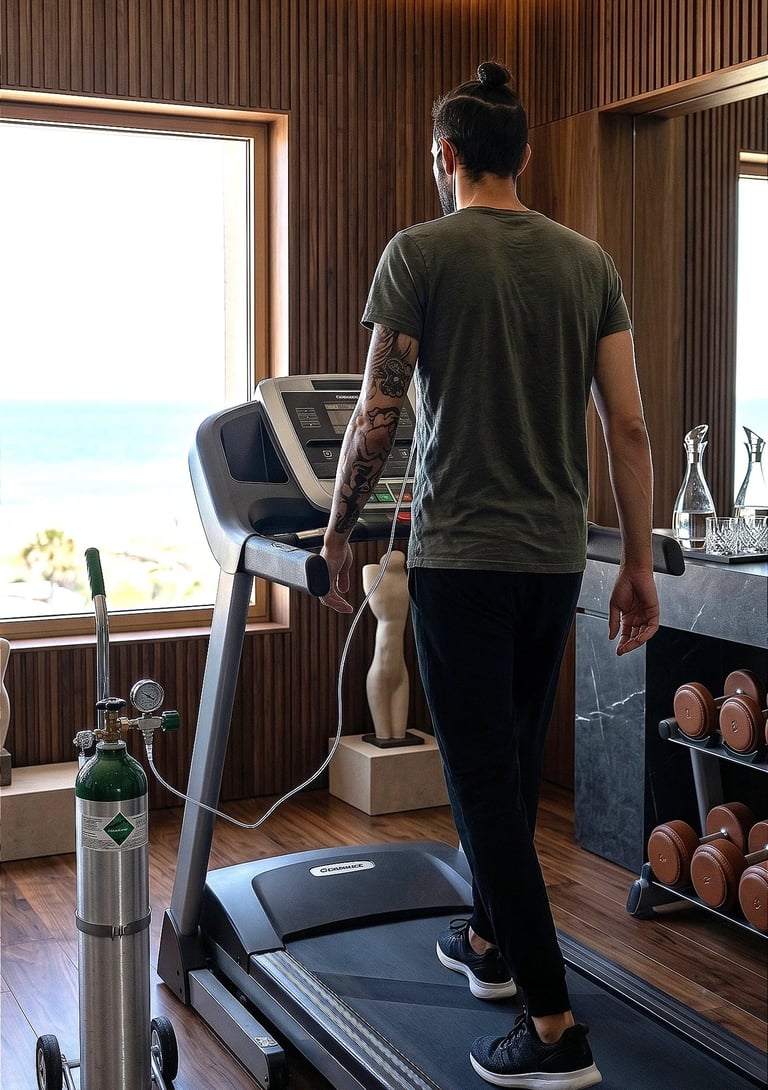
When lung function drops to 13%, traditional exercise models fail. Real progress for long COVID and pulmonary fibrosis patients requires a protocol built on tiny, controlled adjustments and biological feedback loops. This guide breaks down how a patient moved from five minutes of walking on oxygen to running 1.6 kilometers without support.
The Protocol Architecture: Starting At 13% Function
Starting from a state of severe injury requires establishing a stable baseline that the nervous system tolerates without triggering a crash.
The Initial Baseline
Frequency: Every other day to allow recovery.
Duration: 5 minutes.
Speed: 1.0 on the treadmill.
Support: Portable oxygen tank set to maintain safe saturation levels.
The Single Variable Rule: Precision Over Power
The core of this protocol is the 1% adjustment. To avoid overloading a fragile system, you must change exactly one variable per session.
Speed: Incremental increases in treadmill pace.
Time: Adding seconds to the total duration.
Oxygen: Decreasing flow by the smallest measurable margin.
Changing only one variable allows for clear data. If the system crashes, the cause is obvious.
How To Progressively Train Lungs With 13% Function: A Scientific Guide To Oxygen, HRV, And PEM
Lung rehab for severe pulmonary impairment is not about grit. It is about precision engineering.
When lung function drops to 13%, traditional exercise models fail. Real progress for long COVID and pulmonary fibrosis patients requires a protocol built on tiny, controlled adjustments and biological feedback loops. This guide breaks down how a patient moved from five minutes of walking on oxygen to running 1.6 kilometers without support.
The Protocol Architecture: Starting At 13% Function
Starting from a state of severe injury requires establishing a stable baseline that the nervous system tolerates without triggering a crash.
The Initial Baseline
Frequency: Every other day to allow recovery.
Duration: 5 minutes.
Speed: 1.0 on the treadmill.
Support: Portable oxygen tank set to maintain safe saturation levels.
The Single Variable Rule: Precision Over Power
The core of this protocol is the 1% adjustment. To avoid overloading a fragile system, you must change exactly one variable per session.
Speed: Incremental increases in treadmill pace.
Time: Adding seconds to the total duration.
Oxygen: Decreasing flow by the smallest measurable margin.
Changing only one variable allows for clear data. If the system crashes, the cause is obvious.
Biological Feedback: HRV And PEM
The brake pedal for this protocol is Heart Rate Variability (HRV) and Post Exertional Malaise (PEM).
HRV as a Warning System
HRV measures the time difference between heartbeats. It indicates the state of the autonomic nervous system.
Stable HRV: The nervous system has integrated the previous load.
Dropping HRV: The body is stressed or inflamed. The previous step was too large.
Start writing today. Use the button below to create a Substack of your own
Understanding PEM
Post Exertional Malaise is a delayed reaction to overexertion. It often hits 24 to 72 hours after the event. Symptoms include bone deep exhaustion, brain fog, and flu like heaviness. In this protocol, HRV serves as a leading indicator to stop PEM before it starts.
The Science Of Tiny Gains: Why This Works
Moving in microscopic steps triggers three critical physiological adaptations without triggering a threat response.
1. Neuroplasticity and Safety
The brain learns that specific levels of demand are safe. This prevents the fight or flight response that often leads to respiratory panic.
2. Cardiovascular Efficiency
The heart and blood vessels adapt gradually. Improvements in stroke volume and muscle mitochondria occur without the systemic inflammation caused by high intensity training.
3. Respiratory Conditioning
The diaphragm and intercostal muscles are strengthened through repeated, manageable practice. This increases the ability to exchange gases even with compromised lung tissue.
Oxygen Titration: The Controlled Reduction Strategy
The green oxygen tank is a bridge, not a permanent requirement. By very slowly turning down the oxygen flow rate only when HRV is stable, the body is forced to handle a fraction more of the work. This is graded exposure for the respiratory system.
The Feedback Loop Playbook
Execute: Perform the session with one small change.
Monitor: Track HRV, resting heart rate, and sleep for 72 hours.
Analyze: If metrics stay stable, the change is safe.
Pivot: If metrics drop, revert to the previous successful baseline.
The Result: From Five Minutes To 1.6 Kilometers
By the time the patient could run 1.6 kilometers without oxygen, the following biological shifts had occurred:
The heart moved more blood per beat.
Mitochondria became more efficient at using available oxygen.
The nervous system updated its threat settings to register training as normal.
Victory is not the hardest workout you can survive. Victory is the longest streak of sessions you can adapt to without crashing.
Implementation Checklist
[ ] Establish a baseline so small it feels almost pointless.
[ ] Secure a reliable method for tracking HRV and resting heart rate.
[ ] Commit to changing only one variable (speed, time, or oxygen) per session.
[ ] Maintain a 72 hour observation window for PEM symptoms.
[ ] Prioritize consistency over intensity to ensure long term scalability.
Thanks for reading! This post is public so feel free to share it.

Do you have a life changing story and want to help others with your experience and inspiration. Please DM me or Send me an email at the links below
Contact Me
© 2025. All rights reserved.
Privacy Policy