"I Survived. I Lived. Then I Woke Up."

Fixed vs. Growth Mindset: Why Your Inner Commentary is Your Biggest Obstacle
Are you stuck in a "Fixed" mindset? Learn how to rewire your brain for growth, resilience, and high-performance living with the FiTiQ guide to mindset.
Christopher J
2/15/20265 min read
The Software Update for Your Soul: Rewiring the Fixed Mindset
Imagine you are trying to install a high-end, 2026 AI-driven fitness app on a flip phone from 2004. It doesn’t matter how good the code is; the hardware simply can’t handle the processing power.
Most people approach their goals—whether it’s hitting a new PR in the gym or launching a startup in Queens—with "flip phone" thinking. They want 2026 results with a 2004 mindset. At FiTiQ, we call this the "Master Your Inner Commentary" challenge.
As someone with a degree in psychology and a history of rebuilding my own body, I can tell you that the most important "muscle" you will ever train is the one that talks back to you when things get hard.
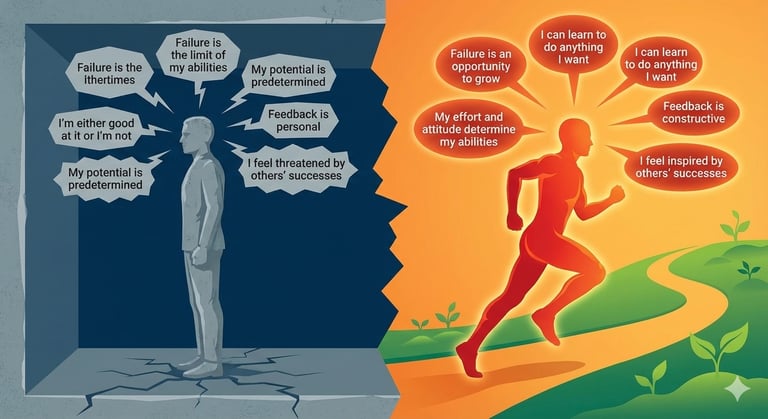
Today, we are looking at the two silhouettes of human potential. One is a statue, frozen in time. The other is a work in progress. Let’s look at the Fixed Mindset vs. the Growth Mindset and see which one is currently running your life.
The Two Silhouettes: A Tale of Two Brains
Look at the image below. It isn't just a diagram; it is a snapshot of the internal negotiation happening in your head right now.
The Fixed Mindset: The "Stuck" Statue
The silhouette on the left represents the Fixed Mindset. This is the belief that your intelligence, your talent, and your physical limits are essentially "baked in" at birth. If you have a fixed mindset, you believe you were born with a certain amount of "IQ" and that’s the end of the story.
"Failure is the limit of my abilities.": When a workout gets too heavy or a project fails, the Fixed Mindset says, "Well, I guess I’ve reached my ceiling".
"I'm either good at it or I'm not.": This is the "Natural Talent" trap. If you aren't an expert by day two, you quit because you think you lack the "gene" for it.
"My potential is predetermined.": This is the ultimate "Huddler" philosophy. It assumes the script of your life is already written, so why bother trying to change the ending?
The Growth Mindset: The "Evolving" Athlete
The silhouette on the right is the Growth Mindset. This is the core of the FiTiQ philosophy. It is the belief that your basic qualities are things you can cultivate through effort and tenacity.
"Failure is an opportunity to grow.": This is Amor Fati in action. You don't just tolerate the failure; you use it as data to get better.
"I can learn to do anything I want.": This is the "Software Update." You realize that with enough "Movement Snacks" and consistency, you can rewire your brain and body for anything.
"My effort and attitude determine my abilities.": You stop being a borrower from the "Bank of Luck" and start being an investor in the "Bank of Effort".
The Psychological "Glitch" of Fixed Thinking
Why do we default to the fixed mindset? Because it’s safe.
If your potential is "predetermined," you have an excuse to stay under the blankets. If you "aren't a gym person," you don't have to face the discomfort of the 12-minute reset. The fixed mindset is an emotional avoidance strategy designed to protect you from the "sharp pain" of the growth process.
But as we’ve discussed with Zephyr, procrastination and avoidance are not laziness; they are a lack of honesty. You are afraid that if you try and fail, it proves you are "less than."
A growth mindset removes that threat. If failure is just an "opportunity to grow," then failure is no longer a judgment on your soul—it’s just a bug in the code that you’re about to fix.
The Stoic Overlap: Actualizing Your Rationality
The Stoics, like Marcus Aurelius, were the original proponents of the growth mindset. They understood the concept of dynamis—the inherent capacity to become something more than you currently are.
However, they also knew that having the potential for a growth mindset isn't enough. You have to move into Actualized Rationality.
Feedback is Constructive: In a fixed mindset, criticism is a personal attack. In a growth mindset, it is free consulting.
Inspiration over Threat: Instead of feeling threatened by someone else’s success, you study their "game film" to see what you can apply to your own life.
Closing the Gap: From Statue to Athlete
Rebuilding your life—whether from a health crisis like spondylosis or a career rut—requires a total overhaul of your "Inner Commentary".
You have to stop talking to yourself like a drill sergeant and start talking to yourself like someone you love. You have to build friction against the "Fixed" escape routes and lower the barrier for the "Growth" steps.
Remember: If you demand excellence on the first step, you will never take the first step. The growth mindset is about the courage to be a beginner over and over again.
Key Takeaways
Mindset is Hardware: You cannot run high-performance goals on a "fixed" operating system.
Failure as Data: In the FiTiQ world, failure is not a limit; it is a diagnostic tool for growth.
Effort over Talent: Your current abilities are not a ceiling; they are a starting line that is moved by effort and attitude.
The Comparison Shift: Move from feeling "threatened" by others to being "inspired" by them. Their success is proof that the process works.
Self-Talk Audit: The way you narrate your setbacks determines whether you stay a "statue" or become an "athlete".
FAQ: Navigating the Mindset Shift
Q: How do I know if I'm stuck in a mental rut? A: Listen for "Fixed" keywords in your self-talk, like "always," "never," or "I'm just not...". If you feel a surge of resentment when someone offers feedback, or if you find yourself avoiding a task because you're afraid of looking "stupid," you are likely operating from a fixed mindset.
Q: Can you actually rewire a brain that's been "fixed" for decades? A: Absolutely. This is the beauty of neuroplasticity. By intentionally changing your response to failure and forcing yourself to take small "Growth" actions (like a 12-minute circuit), you physically create new neural pathways. It takes time, but the brain is the ultimate "Ferrari" that can be upgraded at any age.
Q: Does a growth mindset mean I have to be happy about failing? A: No. You don't have to love the sting of failure, but you must respect the data it provides. It's about shifting from "This is a disaster" to "This is an opportunity to grow". It’s about Tenacity—the grit to stay in the game even when it hurts.
Q: How does this mindset stuff actually affect my physical performance? A: A fixed mindset will make you quit a workout the moment your heart rate spikes because you think you’ve reached your "predetermined limit". A growth mindset recognizes that the burn is just your body adapting to a new level of capability. It’s the difference between a one-time "hustle" and a lifetime of consistency.
Q: What's the quickest way to silence my inner critic? A: Stop trying to silence it and start reframing it. When the critic says, "You aren't good at this," answer with, "I'm not good at this yet". The word "yet" is the ultimate growth mindset hack.

Do you have a life changing story and want to help others with your experience and inspiration. Please DM me or Send me an email at the links below
Contact Me
© 2025. All rights reserved.
Privacy Policy