"I Survived. I Lived. Then I Woke Up."

Epictetus's "Persist and Resist": A Stoic Guide to Ending Toxic Friendships
Why do we keep toxic friends? It's not ignorance; it's a cost-benefit calculation. Learn how Epictetus's "Persist and Resist" philosophy can help you bridge the gap between knowing you should leave and actually doing it.
Christopher J
1/6/20267 min read
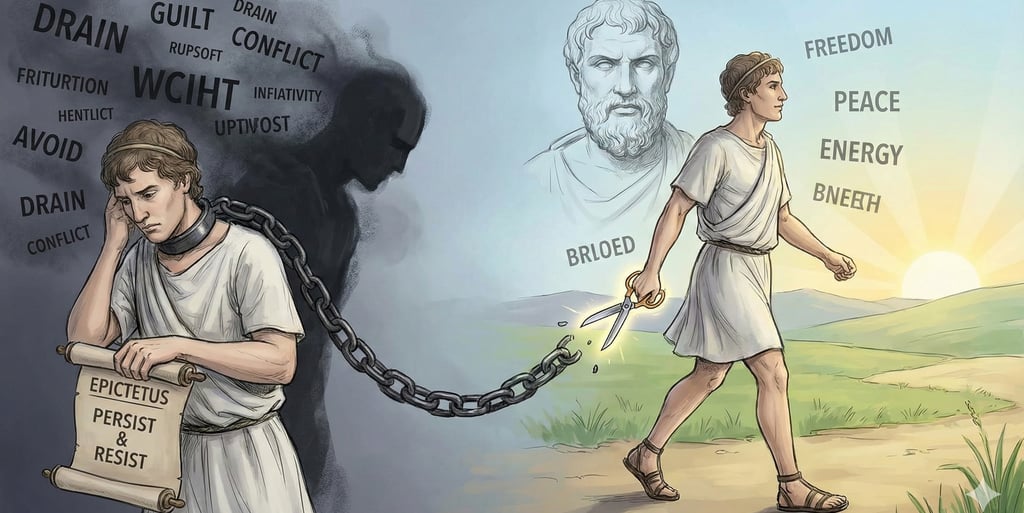
Persist and Resist: Why You Keep That Toxic Friend (And How Epictetus Would Cut the Cord)
Your phone buzzes. You look at the screen. It’s them.
Immediately, your stomach does a little backflip—and not the fun, gymnastic kind. It’s the "dread" kind. You know this person drains your energy, dismisses your achievements, or treats your time like a renewable resource they own. You know the friendship is past its expiration date. In fact, if a friend described this dynamic to you, you’d tell them to run for the hills.
Yet, you swipe "Answer." You make plans. You stay.
Why do we do this? Are we masochists? Are we stupid?
I once kept a pair of running shoes that gave me blisters every single time I wore them. They were expensive, they looked cool, and I kept telling myself, "Maybe my feet just need to toughen up." I endured months of bloody heels not because I didn't know the shoes were the problem, but because the hassle of researching new ones, spending the money, and admitting I made a bad purchase felt heavier than the blister.
Ending a toxic friendship is just like those shoes, but with way more guilt.
We often think we stay in bad situations because we are confused. But the ancient Stoic philosopher Epictetus would argue that you aren't confused at all. You are making a cold, hard calculation. And until you change the math, you will stay stuck.
This is where the Stoic mantra of "Persist and Resist" comes in to save your social life.
The Stoic Formula: Anechou kai Apechou
Epictetus, a man who was born a slave and rose to become one of history’s greatest teachers, summed up his philosophy in two words: Anechou and Apechou.
Persist and Resist.
Persist (Anechou): Endure the difficulties that are necessary for your growth. Bear the weight of doing the right thing, even when it’s heavy.
Resist (Apechou): Abstain from the pleasures or comforts that are bad for your character. Say no to the easy path if it leads to vice.
In the context of that toxic friend, the formula is clear: You must Persist through the immense discomfort of the breakup conversation, and you must Resist the urge to slide back into the familiar comfort of a bad situation.
The Calculation: Why Knowledge Isn't Power
There is a massive lie in the self-help world: "Knowledge is Power."
If knowledge were power, nobody would smoke, everyone would have a six-pack, and toxic exes would never get a second text back.
Knowledge is only potential power. Action is real power.
When you stay in a toxic friendship, it is not because of ignorance. You know it’s toxic. It is not because of inability. You physically possess the ability to say, "I can't see you anymore."
So, what is actually happening?
You are running a subconscious Cost-Benefit Analysis.
Cost of Action: The immediate, sharp pain of the confrontation. The guilt. The awkwardness. The fear of loneliness.
Benefit of Action: Freedom, peace, reclaimed energy (but this feels distant and abstract).
Your brain, which is wired to avoid pain, looks at the immediate cost (The Breakup) and screams, "Too expensive!" It prefers the slow, dull ache of the toxic friendship because it is familiar.
The barrier is the Cost of Change. We choose the misery we know over the uncertainty we don’t.
Shifting the Comparison: The Weight of Unlived Knowledge
To bridge the gap between "I know I should leave" and "I am leaving," you have to rig the math in your favor.
Most of us compare the Pain of Breaking Up vs. The Comfort of Staying.
This is the wrong comparison. The comfort of staying is an illusion; it’s just the absence of acute conflict.
Instead, you need to shift the comparison. Weigh the Cost of Action against the Accumulated Cost of Inaction.
Ask yourself:
"What is the cost of this person draining me for another five years?"
"What opportunities am I missing because I’m emotionally exhausted by them?"
"What does my self-esteem look like in 2030 if I keep letting them treat me this way?"
This is the "Weight of Unlived Knowledge." Carrying around the knowledge that you are betraying yourself is heavy. It erodes your self-trust. When you realize that staying is actually more expensive than leaving, the inertia breaks.
The Dichotomy of Control: Staying in Your Lane
A central pillar of Stoicism is the Dichotomy of Control. You can control your actions; you cannot control others' reactions.
When we hesitate to end a friendship, it’s usually because we are trying to control the uncontrollable.
"What if they get mad?" (Not in your control).
"What if they badmouth me to our mutual friends?" (Not in your control).
"What if they cry?" (Not in your control).
What is in your control?
Your integrity.
Your boundaries.
The words you choose to say.
Epictetus would tell you to focus entirely on your own behavior. Did you act with justice? Did you speak the truth? Did you protect your peace? If yes, then the outcome—whether they scream, cry, or post a vague status update about "fake friends"—is irrelevant to your character.
Overcoming Inertia: Small Steps, Not Giant Leaps
If the idea of a "we need to talk" coffee date makes you want to vomit, stop trying to summon superhero levels of willpower. Willpower is a battery, and yours is likely drained.
Instead, close the gap with micro-actions.
Step 1: Mute their notifications. (Cost: Low. Benefit: Immediate peace).
Step 2: Decline one invite. (Cost: Mild guilt. Benefit: An evening of freedom).
Step 3: delay your response time by 4 hours.
These small acts of Resist build evidence. They prove to your brain that the "cost" is tolerable. You survive the guilt. You enjoy the silence. Slowly, the calculation shifts, and the final step of ending the friendship becomes a natural progression rather than a terrifying cliff dive.
Practical Exercises for the Modern Stoic
You have the theory. Now, how do we actually do this? Here are four practical exercises to help you persist and resist.
1. Journaling the "Cost of Inaction"
Don't just think it; ink it. Sit down and write out the trajectory of your life if you don't end this friendship.
Prompt: "If I am still dealing with [Name]'s drama in 3 years, what will my life look like? What hobbies will I have given up? How much stress will I have absorbed?"
Goal: Make the long-term suffering feel real and visceral, so it outweighs the short-term fear of conflict.
2. Premeditatio Malorum (The Pre-Mortem)
The Stoics practiced Premeditatio Malorum—the premeditation of evils. Instead of hoping the breakup goes well, assume it goes badly and prepare for it.
Exercise: Visualize the conversation. Imagine them yelling. Imagine them guilt-tripping you. Imagine the awkward silence.
The Twist: Now, visualize yourself handling it with calm dignity. See yourself Persisting.
Why: Anxiety thrives on the unknown. By mentally rehearsing the worst-case scenario, you strip it of its power. You realize, "Okay, if they yell, I will just stand there. I won't die."
3. "Act As If" (The Virtue Avatar)
Aristotle and the Stoics believed that we become what we do. If you want to be courageous, you do courageous things.
Exercise: For one week, act as the version of yourself who has high self-worth.
Application: When that text comes in, ask: "What would the version of me who respects myself do?" Then do that. Fake the confidence until the habit forms. You are training your psyche to accept a new norm.
4. Define Purpose Before Action
Before you engage with this person, or before you send the breakup text, anchor yourself in virtue.
Exercise: Ask, "Is ending this friendship an act of Justice (to myself) or Wisdom?"
Result: This reframes the breakup from a "mean thing I am doing to them" to a "virtuous thing I am doing for my life's purpose." It removes the guilt and replaces it with duty.
Epictetus Was Right: It’s About Shoulders
Epictetus once said, "Don't explain your philosophy. Embodiment is the only proof."
He often used the metaphor of wrestling or weightlifting. He didn't care about your theory; he wanted to see your shoulders. He wanted to see the muscle you built by bearing heavy loads.
Ending a toxic friendship is a heavy load. It hurts. It’s scary. But that pain is the friction that polishes you.
You know what you need to do. You have the knowledge. Now, you must choose to pay the cost. You must Persist through the momentary pain of the cut, so you can Resist a lifetime of bleeding out.
Key Takeaways
Knowledge ≠ Power: Knowing a friendship is toxic changes nothing. Only the willingness to endure the "cost" of ending it (discomfort, conflict) creates change.
The "Persist and Resist" Formula: To reclaim your life, you must Persist through the short-term pain of the breakup and Resist the comfort of returning to the familiar dynamic.
Control the Inputs, Not Outputs: Use the Stoic Dichotomy of Control. You control your integrity and your decision to leave; you do not control their reaction, anger, or guilt-tripping.
Shift the Math: Stop comparing the pain of leaving to the comfort of staying. Compare the pain of leaving to the accumulated misery of staying for another decade.
Micro-Resistances: If you can't end it today, start by resisting small things—mute notifications, delay responses, decline small invites—to build your "action muscle."
FAQ: Stoicism, Guilt, and Cutting Ties
Q: Isn't it "Un-Stoic" to cut people off? Shouldn't I be able to endure them? A: Not at all. While Stoicism teaches us to endure external hardships, it also teaches us to protect our own character (our ruling faculty). If a person corrupts your character, triggers vice, or prevents you from living virtuously, removing yourself from their influence is an act of wisdom, not weakness. You are "resisting" the vice they bring into your life.
Q: I feel immense guilt when I think about leaving. How do I handle that? A: Epictetus would remind you that guilt is an internal judgment, not an external fact. You are judging yourself for "hurting" them. Reframe this: You are not hurting them; you are removing your consent to be mistreated. You are prioritizing the "greater good" of your own mental freedom. Guilt is often just the "cost of change" disguised as morality.
Q: What if I try to end it and they promise to change? A: This is a test of your resolve. Look at the evidence (the past), not the words (the future). A Stoic looks at reality as it is, not as we wish it to be. If their character has consistently been toxic, persist in your decision. Words are cheap; patterns are reality.
Q: How do I apply "Premeditatio Malorum" without giving myself an anxiety attack? A: The goal isn't to scare yourself; it's to prepare. Don't just visualize the bad thing happening; visualize yourself coping with it successfully. See the conflict, but then see yourself taking a deep breath and remaining calm. You are rehearsing your victory, not your demise.
Q: Can I just "quiet quit" the friendship instead of having a confrontation? A: Sometimes, yes. If a confrontation would be unsafe or unproductive, slowly withdrawing your energy (the "micro-steps" mentioned above) is a valid strategy. However, be honest with yourself: are you quiet quitting because it's the virtuous path, or because you are avoiding the "cost" of a difficult conversation? Courage is a virtue; avoidance is not

Do you have a life changing story and want to help others with your experience and inspiration. Please DM me or Send me an email at the links below
Contact Me
© 2025. All rights reserved.
Privacy Policy