"I Survived. I Lived. Then I Woke Up."

Seneca on Courage: My COVID Coma, Pulmonary Embolism, and Resetting for 2026
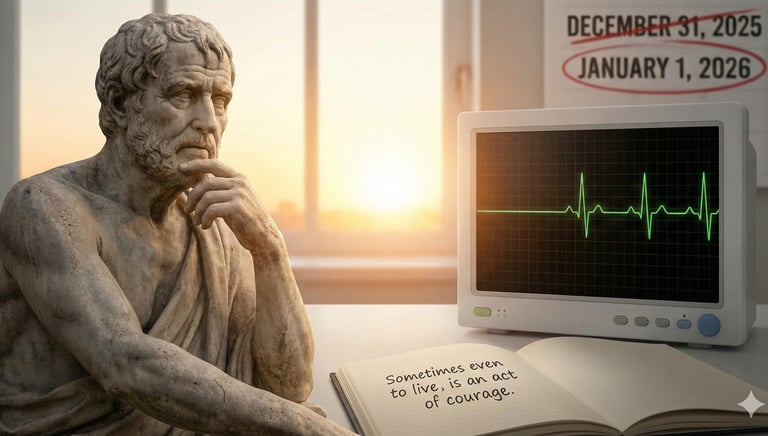
"Sometimes even to live, is an act of courage." A personal story of surviving a 55-day COVID coma, fighting back from paralysis, and using Stoic philosophy to conquer a medical crisis.
STOIC WISDOMMY STORY AND JOURNEYHEALTH & WELLNESS
Chritopher J
12/30/20258 min read
I Died for 55 Days (It Was Overrated): How Faith and a Roman Philosopher Played a Huge Role.
You know those movies where the hero survives a near-death experience? They wake up in a sun-drenched hospital room, immediately rip out their IVs with zero consequences, look out the window pensively, and decide to seize the day.
Let me tell you, Hollywood is lying to you.
My near-death experience didn’t feature warm lights or deceased relatives beckoning me toward peace. It featured the rhythmic, robotic whoosh-clunk of a ventilator doing my breathing for me, neon hospital lights that buzzed with the enthusiasm of a dying fly, and the realization that I couldn't scratch my own nose.
Seneca, the Roman Stoic philosopher, didn't have access to modern ventilators or physical therapy, but he understood the crushing weight of human suffering better than most. His words became my lifeline when the morphine couldn't touch the existential dread: "Sometimes even to live, is an act of courage."
As the final hours of 2025 slip away, I find myself reflecting on that specific brand of courage. It is not the courage of charging into battle. It is the quiet, agonizing, unglamorous courage of simply refusing to let go when gravity is trying to pull you under. If you are reading this, you have survived your own battles this year. You are still here. And as we prepare to cross the threshold into 2026, it is time to recognize that survival itself is a victory worth celebrating.
The Ultimate "Hold My Beer" Moment
July 2021. I was 30, a fitness coach, and feeling absolutely bulletproof. I had just proposed to the love of my life in Key West. Life was peak. I was on top of the mountain.
Apparently, the universe saw me and said, "Watch this."
A few days later, I felt a little under the weather. I went for a nap on July 18th, expecting to wake up in an hour.
I woke up in September.
Fifty-five days. That’s how long the Delta variant of COVID-19 kept me in a medically induced coma. While I was taking the world's worst nap, my body turned into a disaster movie. Both my lungs collapsed, my heart went into a-fib three times. I went septic twice. My right kidney failed. My muscles basically dissolved into toxic sludge (rhabdomyolysis for the nerds). I went from a solid 194 pounds of muscle to a 104-pound skeleton draped in skin.
When I finally woke up on September 11, I was paralyzed. I had three tubes in my chest, a hole in my neck to breathe (tracheotomy), and a tube in my stomach for food. The doctors looked at my scarred lungs and basically gave me the "thoughts and prayers" face. They told me oxygen tanks were my new permanent accessory.
Redefining Courage (Or: How to Be Stubbornly Alive)
Seneca’s quote about the "courage to live" sounds lovely on a Pinterest board. It hits differently when you are staring at the ceiling, trying to mentally Jedi-mind-trick your big toe into wiggling.
I realized that courage isn't some adrenaline-fueled charge into battle. That’s easy stuff. Real courage is boring. Real courage is painful. Real courage is the sheer, agonizing repetition of trying to sit up on the edge of the bed without passing out, even though you used to squat double your body weight.
"Sometimes even to live..." means the other option was on the table. Checking out was tempting. It would have been so easy to just close my eyes and drift away. Choosing to stay awake, to endure the suctioning of the lung tubes, to feel the burn of atrophied muscles—that was an active, violent choice I made every second.
I had to separate "me" from my broken body vessel. I was just a stubborn consciousness trapped in a lemon of a car. But I decided I was going to drive that lemon until the wheels fell off.
The Reconstruction Montage (Cue the 80s Music)
Here is the thing about healing they don't tell you: It is warfare.
The doctors saw "permanent disability." I heard "challenge accepted." I treated recovery like the most important job in the world. If physical therapy said I could walk 10 feet, I walked 12, sweating and shaking like a leaf the whole time.
I strapped a portable oxygen tank to my back like the world’s lamest Ghostbuster and got on the treadmill. Every step was a hostage negotiation with my scarred lungs. It sucked. I hated it. I did it anyway.
And slowly, the "impossible" happened. The fibrosis cleared up. The skeleton started putting on muscle.
Three years later, I was back to 198 lbs. My lung function went from a terrifying 13% to 51%. I threw the oxygen tank in the closet. I reclaimed my life through sheer audacity.
The 2025 Plot Twist: Seriously, Universe?
You’d think after surviving all that, I’d get a free pass for a decade or so, right?
Nope. Fast forward to October 4, 2025—just a few months ago. I woke up with a calf cramp. I’m a tough guy survivor, so I ignored it. By the afternoon, my leg looked like a sausage casing about to burst. My gut screamed Blood Clot.
Ding ding ding. We have a winner. A massive Deep Vein Thrombosis (DVT), probably a parting gift from Long COVID, had thrown clots into my lungs. Two pulmonary embolisms (PEs).
Suddenly, I was back to square one. I was mortal again. I was terrified again. And just for fun, they diagnosed me with Type 2 diabetes on top of it.
This is where I had to upgrade my Seneca philosophy.
In 2021, courage was about Force—pushing, grinding, fighting. In late 2025, while on blood thinners and risking sudden death if I pushed too hard, courage had to become about Patience.
We live in a hustle culture that worships the grind. But when you have a PE, "grinding" will straight-up kill you. I had to learn what I call "Active Patience."
I wasn't "napping." I was engaging in high-level cellular repair. I wasn't "being lazy." I was strategically allowing my blood thinners to do their job without interference. Don't disturb the genius at work, okay?
Courage sometimes looks like restraint. It’s having the discipline to sit your butt down when your brain wants to run.
The Great 2026 Reset: Dump the Baggage
So here we are. December 30, 2025. The year is almost dead. Good riddance.
Look, maybe you didn't fight off a coma or blood clots this year. But maybe you fought off depression. Maybe you survived a toxic job, a brutal breakup, or just the crushing weight of inflation and existential dread.
Guess what? You made it.
Seneca also said, "A gem cannot be polished without friction."
We are all walking into 2026 looking a little scuffed up from the friction of 2025. But we’re also shinier. We’re harder. We know what we can take.
There is tremendous pressure right now to set New Year's resolutions. Forget that. Let's do something better. Let's perform a controlled burn of the past year.
Wipe the Slate Clean.
Carrying the trauma, fear, and "why me?" energy of 2025 into 2026 is like wearing a heavy winter coat in the swimming pool. You survived the storm; you don't need to keep wearing the wet clothes.
Admit it Sucked: Don't toxic-positivity your way out of this. 2025 was hard. You were scared. Validate that.
Own Your Badassery: You didn't quit. On the days you wanted to stay under the covers, you got up. That is the "courage to live" Seneca was talking about. Give yourself some credit.
Flip the Script: I could wake up on January 1st thinking of myself as a "victim" of COVID. Or, I can wake up as a Warrior who looked death in the face and said, "Not today, pal." The events happen to you, but you write the story.
Why 2026 Is Going to Be Your Year
Surviving is just the baseline. It’s keeping the meat-sack functional. Living? That’s the fun part that comes next.
For me, 2026 is about intentionality. I’m not just "not dead." I am aggressively alive. I am breathing air into lungs that weren't supposed to work.
Whatever limitations the world has slapped on you this year—medical, financial, emotional—I challenge you to defy them. Not with blind arrogance, but with the quiet, smug conviction of someone who knows they are tougher than their circumstances.
My lung function didn't triple because I wished for it. It tripled because I acted like it had no choice but to improve. Your 2026 can be the same.
The noise of life gets a lot quieter when you've heard the silence of the ICU. The petty dramas don't sting as much. You realize that every single inhale is a free gift, and every exhale is a victory lap.
So, take a deep breath. Feel that? That’s the feeling of winning. You did the brave thing. You lived.
Now, go make 2026 count.
Key Takeaways
Survival is a Flex: Seneca was right—when life gets unbearable, the simple, stubborn choice to keep breathing is a massive act of bravery. You don't need to climb Everest to be courageous; sometimes just getting out of bed is the gold medal event.
Labels Are Suggestions, Not Destinies: Whether the world labels you "permanently disabled," "broke," or "broken," remember that those are just opinions. With discipline and a refusal to quit, you can bend reality quite a bit.
Leave the Dumpster Fire in 2025: As we cross into 2026, acknowledge the trauma of the past year as the friction that polished you into a shinier gem. Don't drag the emotional baggage into the new year. Rewrite your story from "victim" to "undefeated champion.
FAQ: Resilience, Recovery, and Why a Dead Roman Guy Matters
Q: Who was Seneca and why should I care what he thought? A: Imagine the toughest, smartest guy you know, put him in a toga, and give him a job advising a psychopathic emperor (Nero). That’s Seneca. He dealt with exile, political backstabbing, and chronic health issues like asthma and tuberculosis. He didn't write theoretical philosophy from an ivory tower; he wrote a practical survival guide for a brutal world. He’s relevant because human suffering hasn't changed in 2,000 years—we just have better Wi-Fi now.
Q: How do you stay positive when everything is going wrong? A: Here’s the secret: You don't. Trying to be "positive" 100% of the time is exhausting and fake. Aim for "neutral resilience." It’s okay to have a pity party—just don't unpack your bags and live there. Focus on micro-wins. Don't try to run a marathon today; just try to put on your socks without crying. Small victories compound.
Q: What is "Active Patience"? It sounds like an excuse to be lazy. A: How dare you! Active Patience is strategic rest. When you break a bone, you don't keep hitting it with a hammer to "toughen it up." You cast it and rest it. When you are recovering physically or mentally, rest isn't the absence of work; it is the primary work. It takes discipline to slow down when your anxiety is telling you to speed up.
Q: Is it really possible to recover from "permanent" damage like you did? A: Look, I'm not a doctor, I’m just a guy who refused to listen to odds. Every body is different. But I believe the human body and mind are capable of wild things when pushed correctly. "Permanent" is often just a label based on averages. You are not an average. Always work with your medical team, but never stop being the CEO of your own recovery.
Q: How do I "wipe the slate clean" if my problems are still here in 2026? A: Wiping the slate doesn't mean your debt, illness, or grief magically poofs into thin air on New Year's Day. It means resetting your relationship to those problems. You might still have the same baggage, but you don't have to carry the same fear, self-pity, or victimhood about it. You enter 2026 not as someone crushed by 2025, but as an expert in surviving it.


Do you have a life changing story and want to help others with your experience and inspiration. Please DM me or Send me an email at the links below
Contact Me
© 2025. All rights reserved.
Privacy Policy