"I Survived. I Lived. Then I Woke Up."
Your Body Isn’t a Rental: How to Build a Precision Health Ecosystem with AI
Stop following "average" fitness advice. Learn how AI, wearables, and biological aging tracking create a personalized health loop that actually works.
Christopher J
3/2/20263 min read
The Average is Dead (And I Almost Was, Too)
Let’s be real: most "wellness" advice is about as personalized as a fast-food menu. For decades, the industry has treated us like mass-produced sedans, handing out the same 2,000-calorie diets and "hit the gym three times a week" templates to everyone from 19-year-old athletes to 60-year-old CEOs.
That model isn't just broken; it’s obsolete.
At 30, life was basically healthy,, and freshly engaged. Then, plot twist: I skipped the honeymoon phase and went straight to the medical drama. One moment I was living the dream, the next, I was starring in a 55-day coma with a 3% survival rating. When I woke up, I was down to 114 pounds couldn’t move, and was accessorizing with tubes like it was a new fashion trend.
The official prognosis? Forget “happily ever after,” I’d be oxygen for the remainder of my life" - said the DR.
I politely declined that reality.
I didn’t bounce back by taking “average” advice. I used my background in fitness and psychology to design a custom rehabilitation plan. Now, we have something I wish I’d had back then: an AI-powered precision health ecosystem. We’re shifting from guesswork to data-driven discipline.
The Three Pillars of Your New Biological Empire
We are witnessing a "Holy Trinity" of tech that is rewriting what it means to be human.
1. AI-Driven Mental Health: Your Digital Guardian Angel
Mental health isn't just a vibe; it's a metric. AI tools can now analyze your digital habits and workflows to tell you when your brain is redlining before you even feel the burnout. Instead of a generic "take a breath" notification, it suggests a pivot exactly when your cognitive load is at its peak. It’s about deploying your energy where you have the most leverage.
2. Biological Aging: Stop Lying About Your Age
Chronological age is just a number on a driver's license. Your biological age—measured via epigenetic clocks—tells the real story of your cellular health. If you’re 35 but your cells are acting like they’re 50, you need to know. This shifts the focus from vanity metrics (how you look in a mirror) to cellular longevity (how long you’ll actually stay in the game).
3. Wearables: The Boss of Your Gym Routine
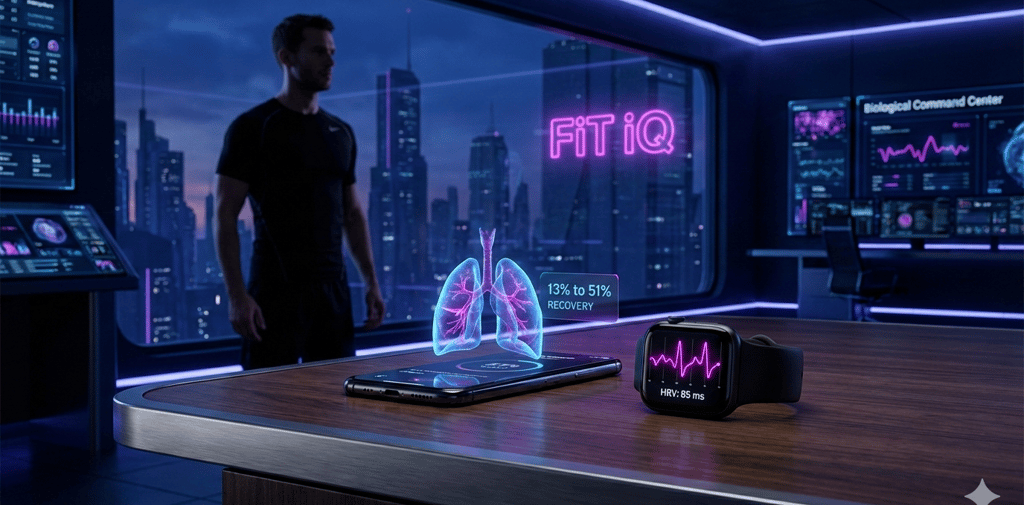
Your wearable should be more than a glorified step counter. Modern telemetry—Heart Rate Variability (HRV), respiratory rates, and glucose spikes—allows your plan to adapt in real-time. If your recovery metrics are trashed, your AI coach should pivot your heavy squats to a mobility session. The tech protects you from your own ego.
The FiT iQ Method: Systems Thinking
At FiT iQ, we don’t look at health in a vacuum. It’s a network. Your sleep affects your insulin, your insulin affects your brain, and your brain affects your bottom line.
When I was rebuilding my body from 104 lbs back to a healthy 198 lbs, I learned that you cannot fix one component without addressing the entire system. Precision tools finally allow us to see the "invisible" connections between our daily habits and our biological output.
The Playbook: Engineering Your Feedback Loop
Want to stop flying blind? Here is your definitive playbook for biological command:
Establish the Telemetry: You can’t optimize what you don’t measure. Wear your tech for 14 days. Don't change a thing. Just collect the raw data on your sleep and activity.
Identify the Bottleneck: Is it the 3 PM coffee? The 10 PM blue light? Find the one thing trashing your HRV.
The Micro Adjustment: Change one variable. Shift your meal by an hour or adjust your light exposure.
Measure and Iterate: Let the cold, hard data tell you if it worked. If your sleep scores go up, lock it in. If not, trash it and move on. This is how you compound biological interest.
Key Takeaways
Averages are for losers: Your biology is unique; your health plan should be, too.
Listen to the tech: Use HRV and deep sleep data to dictate your training intensity.
Focus on the 80/20: 20% of your habits drive 80% of your results. Focus on recovery metrics first.
Biological Age > Chronological Age: Measure the health of your cells, not the years on the calendar.
FAQs
Q: Do I really need a wearable to be healthy? A: You don't need one to survive, but you need one to optimize. It’s the difference between driving a car with a dashboard and driving one with the windows blacked out.
Q: Is AI for mental health actually effective? A: Yes, because it removes the "subjective bias." We often think we’re "fine" when our neurological data shows we are under massive stress. AI doesn't lie to itself.
Q: How do I lower my biological age? A: Through iterative testing. Use the feedback loop to see which nutritional and movement changes actually impact your cellular markers.
Do you have a life changing story and want to help others with your experience and inspiration. Please DM me or Send me an email at the links below
Contact Me
© 2025. All rights reserved.
Privacy Policy