"I Survived. I Lived. Then I Woke Up."
The 8-Hour Sleep Myth: Why You Don't Need "Perfect" Sleep (FITIQ)
Dr. Jen Gunter debunks the 8-hour sleep rule. Learn why sleep anxiety and orthosomnia are ruining your rest, and how to actually measure sleep quality.
MENTAL HEALTH INSIGHTSHEALTH & WELLNESS
Christopher J
1/5/20267 min read
The 8-Hour Sleep Myth: Why Your Obsession with "Perfect" Rest is Keeping You Awake
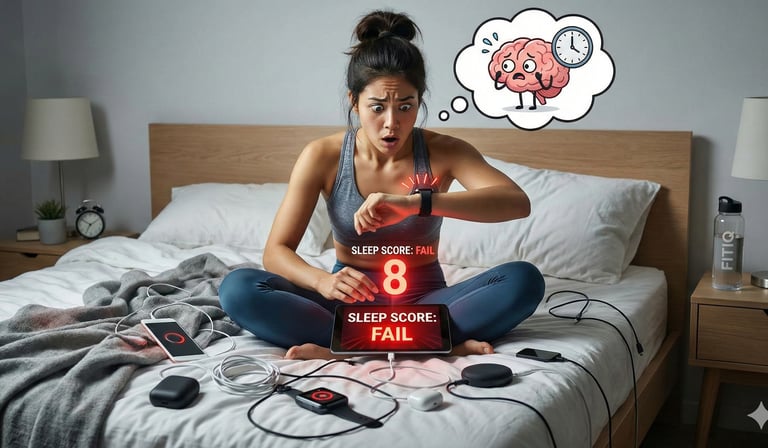
It is 3:17 AM. You know this because you have checked your phone four times in the last twenty minutes.
You do the mental math—the "Panic Arithmetic" that every human knows intimately. Okay, if I fall asleep right this second, I can get exactly four hours and forty-three minutes of sleep. That’s not enough. I’m going to die young. My metabolism will crash. I’ll forget my own name at the meeting tomorrow.
Sound familiar?
Welcome to the club. At FITIQ, we are obsessed with optimization. We track macros, we log reps, and we monitor our heart rate zones. But recently, we stumbled upon a truth bomb dropped by Dr. Jen Gunter in her "Body Stuff" series for TED that shook our smart-watch-wearing wrists to the core.
It turns out, the Holy Grail of health—the rigid, non-negotiable "Eight Hours of Sleep"—might actually be the very thing making us exhausted.
Today, we are taking a deep dive into the science of sleep, stripping away the anxiety, and asking the question: Do you really need eight hours, or do you just need to chill out?
The Cult of the Number Eight
Somewhere along the line, the number eight became the gold standard for wellness. It’s right up there with "10,000 steps" and "drink 8 glasses of water" (spoiler: those are also largely arbitrary marketing numbers, but that’s a rant for another blog post).
We have been conditioned to believe that sleep is a binary pass/fail test.
8 Hours: You are a glowing deity of health, productivity, and clear skin.
7 Hours and 59 Minutes: You are a crumbling ruin of a human being, destined for chronic illness and undereye bags the size of carry-on luggage.
Dr. Jen Gunter points out that this specific number is actually a massive oversimplification. It is an average.
Let’s put this in FITIQ terms. The average shoe size for men in the US is a 10.5. If you have size 12 feet, trying to cram them into a size 10.5 shoe isn't "optimizing your footwear"—it’s painful and stupid. Conversely, if you are a size 9, wearing a 10.5 makes you look like a toddler wearing their dad's work boots.Sleep is biological, not mechanical. The range for healthy adults is typically between seven and nine hours. Some genetic outliers (the "short sleepers") are totally fine with six. Others (the "long sleepers") genuinely need nine or ten to function.
By fixating on the number eight, we are trying to force a bell curve into a single data point. And frankly, it’s stressing us out.
"Orthosomnia": When Tracking Goes Wrong.
We love data here at FITIQ. Give us a graph showing our bench press progress, and we are happy. But sleep tracking has birthed a new, slightly terrifying condition called Orthosomnia.
Derived from "ortho" (correct) and "somnia" (sleep), this is the obsession with achieving "perfect" sleep data.
Here is the scenario: You wake up feeling pretty good. You stretch, the sun is shining, and you feel ready to crush your morning workout. Then, you look at your wrist.
Your Sleep Score: 64. Needs Improvement. REM Sleep: Low. Recovery: Trash.
Suddenly, you feel tired. The placebo effect kicks in reverse. You convince yourself that because the algorithm said you slept poorly, you must feel terrible.
Dr. Gunter argues that these expensive gadgets and trackers often fuel anxiety. They gamify rest, but unlike a video game, you can't "try harder" to win at sleep. In fact, trying harder is the worst possible strategy. Sleep is like a cat—if you ignore it, it will eventually come sit on your lap. If you chase it around the room screaming "LOVE ME," it will scratch you and hide under the couch.
If you are spending your nights staring at a glowing green light on your wrist, wondering why your "Deep Sleep" percentage isn't optimal, you are suffering from the very problem you are trying to solve.
The Anxiety Feedback Loop
The most ironic part of sleep deprivation is that the fear of sleep deprivation is often what keeps us awake.
Dr. Gunter explains that worrying about the health consequences of poor sleep puts your body into a state of hyperarousal. You lay in bed thinking, I read that article on FITIQ about how lack of sleep raises cortisol, so now I’m stressed about my cortisol, which is raising my cortisol.
It is a self-fulfilling prophecy.
When you classify a night of 6.5 hours as a "failure," you start the day with a deficit mindset. You skip the gym because "I didn't recover enough." You eat junk food because "I need the energy." You snap at your coworkers because "I’m sleep-deprived."
But what if you just... didn't care?
What if you woke up after six hours, shrugged, said, "Eh, I'll go to bed earlier tonight," and went about your day? The physiological impact of missing an hour of sleep is often far less damaging than the psychological stress of obsessing over it.
The "Body Stuff" Litmus Test: How to Actually Measure Sleep
So, if we toss our trackers in the trash (or at least stop treating them like religious texts) and ignore the 8-hour rule, how do we know if we are sleeping enough?
Dr. Gunter proposes a radical, high-tech diagnostic tool: How do you feel?
Revolutionary, right?
Here is the FITIQ x Dr. Gunter Checklist to determine if you have a sleep problem:
Do you feel rested when you wake up? (After the initial 15 minutes of "sleep inertia" wears off).
Can you stay awake during the day without forcing yourself? (i.e., not falling asleep while driving or sitting in a boring meeting).
Do you sleep when you have the opportunity? (When your head hits the pillow, are you out within 15-20 minutes?)
If you answered "Yes" to feeling okay and functioning normally, you do not have a problem, regardless of whether you slept 7 hours or 8.5 hours.
If you are functioning well during the day, your body is getting what it needs. Your biology is smarter than an app. It knows how to prioritize deep sleep and REM cycles based on your fatigue levels.
When You Actually Have a Problem (And What to Do)
Now, let’s be real. Some of you are struggling. You are dragging yourself through the day, pounding energy drinks, and feeling like a zombie.
If you legitimately have insomnia or chronic sleep issues, Dr. Gunter—and the team here at FITIQ—suggest that lavender sprays and melatonin gummies probably aren't going to cut it.
The gold standard for treating sleep issues is CBT-I (Cognitive Behavioral Therapy for Insomnia).
CBT-I isn't about pills; it's about retraining your brain. It involves restrict sleep (counter-intuitive, we know) to build up "sleep pressure," and breaking the psychological association between your bed and "tossing and turning."
It teaches you that the bed is for two things only: Sleep and... well, cardio that doesn't happen on a treadmill. If you aren't doing one of those two things, get out of bed. Go read a boring book on the couch. Do not lay there doing the "Panic Arithmetic."
The FITIQ Verdict
We need to treat sleep like we treat our diet. In nutrition, we know that one "bad" meal doesn't make you unhealthy, and obsessing over every single calorie can lead to disordered eating.
Similarly, one "bad" night of sleep won't kill you. A few weeks of averaging 7 hours instead of 8 won't destroy your gains.
Health is a long game. It is about trends, not singular data points.
So, tonight, here is your challenge: Take off the watch. Cover the clock. turn off the phone. Trust your body to do the thing it has evolved to do for millions of years.
Stop counting hours. Start counting how good you feel.
Key Takeaways
The "8-Hour Rule" is a Myth: It is merely a statistical average, not a biological mandate. Most healthy adults need anywhere between 7 and 9 hours.
Orthosomnia is Real: The obsession with "perfect" sleep data from trackers can actually cause anxiety and worsen your sleep quality.
Function Over Metrics: The best indicator of sleep health isn't a number on a screen, but how you feel and function during the day.
Anxiety is the Enemy: Stressing about the long-term health effects of missing sleep often does more damage than the missed sleep itself.
Treat the Root Cause: If you have chronic issues, skip the gadgets and supplements; look into Cognitive Behavioral Therapy for Insomnia (CBT-I).
FAQ: Sleep, tracking, and The FITIQ Lifestyle
Q: But wait, I feel terrible if I don't get 8 hours. Am I imagining it? A: Not at all! You might be a person who biologically requires 8 or even 9 hours. That is your "shoe size." The problem arises when someone who needs 7 hours forces themselves to stay in bed for 8, causing fragmentation, or when someone who needs 9 feels guilty for "oversleeping." Listen to your body, not the average.
Q: Can I "catch up" on sleep on the weekends? A: It is a controversial topic, but generally, you can pay back some sleep debt. However, messing with your wake-up times drastically (like waking up at 6 AM on Friday and 11 AM on Saturday) causes "Social Jetlag." It throws off your circadian rhythm. Try to keep your wake-up time relatively consistent, even on Sundays.
Q: I track my sleep and it helps me. Do I have to stop? A: If tracking gives you insights and doesn't cause you stress, keep doing it! Orthosomnia only applies if the data is making you anxious or if you are prioritizing the "score" over how you actually feel. If you wake up feeling great, but the app says "Bad Sleep," believe your body, not the app.
Q: Does napping count toward my total hours? A: Naps are a great tool, especially for athletes and the fitness-focused crowd at FITIQ. They can boost alertness and recovery. However, if you are napping for 2 hours during the day and then can't fall asleep at night, you are stealing from your "sleep drive." Keep naps under 30 minutes (the power nap) or go for the full 90 minutes (a full sleep cycle), but try to avoid them too close to bedtime.
Q: What is the single best thing I can do for better sleep tonight? A: Get morning sunlight. It sounds unrelated, but viewing bright light within an hour of waking up sets your circadian clock for the whole day. It tells your body "start the timer for melatonin release in 14-16 hours." Also, put the phone away. Doomscrolling is the enemy of dreams.
Do you have a life changing story and want to help others with your experience and inspiration. Please DM me or Send me an email at the links below
Contact Me
© 2025. All rights reserved.
Privacy Policy